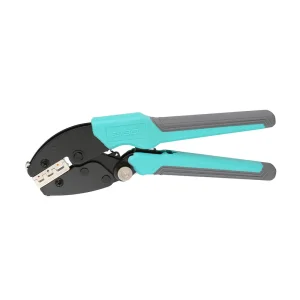
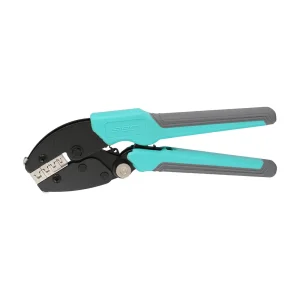
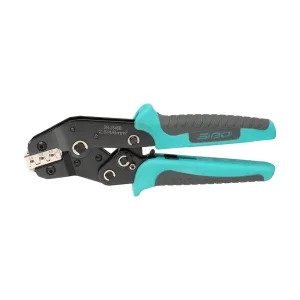
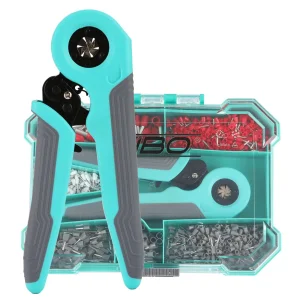
Industrial-standard ratcheting tools and precision crimping instruments built for zero-failure electrical terminations across automotive, solar PV, and control cabinets.
Evaluating crimp integrity, mechanical stress thresholds, and international standardization trends shaping critical infrastructure connectivity.
In modern electrical systems, soldering has been largely superseded by cold-weld compression crimping. According to international standards like DIN EN 60352-2 and UL 486A-486B, an optimal crimp creates a gas-tight interface that excludes corrosive gases, oxygen, and ambient humidity. When proper force curves are attained through high-leverage ratchet mechanisms, the copper strands of the cable fuse with the terminal wall into a quasi-solid homogenous mass. This configuration reduces joint resistance below standard conductor thresholds, effectively eliminating hot-spot ignition hazards in high-amperage panels.
The global transition to renewable microgrids and e-mobility has elevated tool performance requirements. Solar PV arrays operating at 1000V to 1500V DC require connectors (such as MC4 standard profiles) capable of surviving decades of ultraviolet exposure, radical thermal expansion cycles, and continuous environmental moisture. Under-crimped contacts lead to increased thermal resistance, localized plasma arcing, and severe module failure. SIBO Tools engineers specialized die profiles with micro-tolerance EDM matching to ensure crimped contacts retain over 98% mechanical tensile pull-out values under IEC 62852 mandates.
In high-density harness manufacturing and industrial switchgear assembly, a single technician may execute over 1,500 crimps per shift. Conventional manual crimping pliers impose severe wrist torque and excessive muscle recruitment. Advanced industrial tools integrate compound leverage toggle linkages, calibrated automatic ratchets, and bi-component thermoplastic elastomer (TPE) handles. These ergonomic enhancements drop the peak squeeze force requirement by up to 35%, preventing operator fatigue while guaranteeing that incomplete cycle release is physically impossible without activating the emergency disengagement lever.
Situated in the heart of China’s electrical manufacturing epicenter, Yueqing Sibo Tools leverages unmatched geographical and supply-chain integration.
Located in Yueqing, Zhejiang—the undisputed global capital for low-voltage electrical apparatus—our production facilities are within minutes of certified metallurgical suppliers, specialized heat-treatment plants, and precision electroplating houses. This ultra-dense industrial cluster shortens mold design iterations from months to days and drives raw material costs down without compromising high-carbon alloy steel integrity.
A crimping tool is only as durable as its die and pivot pin. SIBO implements continuous vacuum salt-bath hardening and controlled carburizing, bringing high-stress jaw sections to 42–48 HRC and cutting blades to 58–62 HRC. This metallurgical control prevents die cavity widening under repeated compression cycles, preserving strict micron tolerances across thousands of continuous cycles in harsh factory conditions.
From customized dual-color TPR handle moldings and laser-etched private branding to entirely bespoke EDM electrical discharge machining of proprietary terminal jaws, our internal R&D engineering group can produce working prototypes within 10 to 15 business days. We bridge the gap between Western industrial ergonomics and China's lean manufacturing scalability.
Engineered to handle varied mechanical requirements—from micro-gauge signal wiring to large-gauge industrial power distribution.
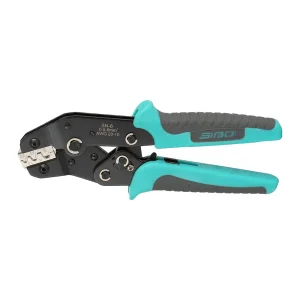
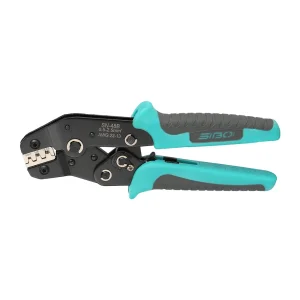
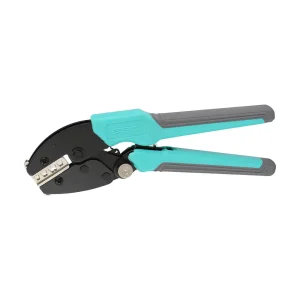
Utility-scale and rooftop PV systems require water-tight connections over 25+ years. Tools like the SN-2546B and SO-2546 series provide specialized precision locator dies that hold solar contacts in the exact axis, avoiding terminal deformation and high thermal resistance.
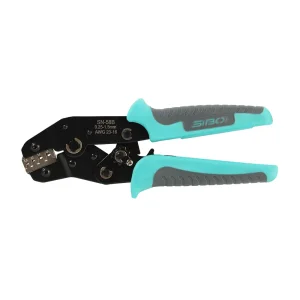
Automotive electronics rely on miniature open-barrel connectors (such as AMP, Delphi, or Molex). Our SO-04BPro and SN-48B tools execute precision "B-crimp" formations, simultaneously capturing the conductor core and the insulation sleeve for optimal vibration dampening.
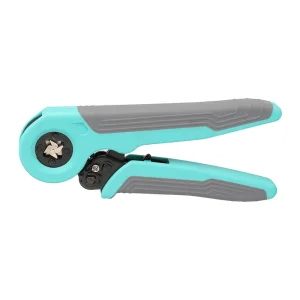
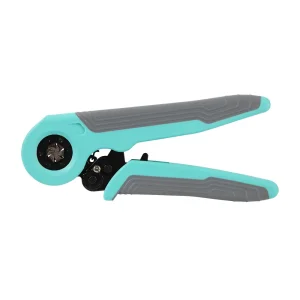
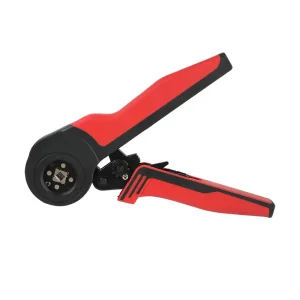
Control cabinet assembly demands neat ferrule terminations into dense spring-clamp terminal blocks. SIBO’s SO 10-4 and SO 10-6 self-adjusting crimpers apply square or hexagonal compression across 0.08–16mm² wire sizes automatically, eliminating die swapping.
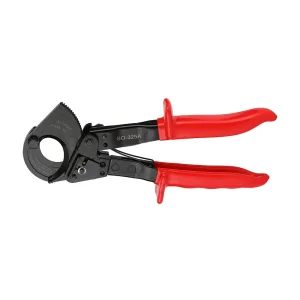
A clean, perpendicular cut without stranding flare is essential before crimping. Our FST-325A ratchet mechanical cable cutters feature high-leverage planetary shear geometry to slice smoothly through copper and aluminum conductors without crushing the core.
Key procurement criteria professional buyers look for when auditing China-based crimping tool manufacturers.
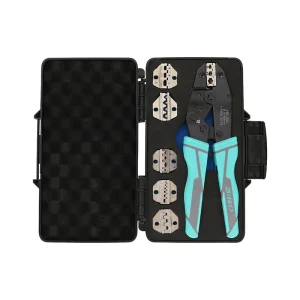
Procurement departments favor versatile modular kits over single-purpose hand tools. Kits like our HS-30J combination package with five interchangeable quick-swap jaws cover insulated, non-insulated, cord-end ferrules, and solar contacts in a single portable Oxford fabric case. This setup reduces distributor inventory carrying costs (SKU sprawl) while providing end-users with comprehensive field coverage.
Commercial buyers understand that a crimper that wears out after 1,000 cycles results in costly field recalls and terminal connection failures. SIBO focuses on long-term value: high-carbon alloy structural frames, cold-stamped ratchets, and replaceable die assemblies tested to exceed 30,000 continuous crimp cycles, lowering per-crimp operating costs over the tool's lifespan.
Global wholesale distributors, online marketplace brand owners, and electrical retail chains increasingly order complete all-in-one installation kits. By bundling our self-adjusting ferrule crimping pliers (SO 10-4 or SO 10-6) with organized compartments of 1,200 to 1,820 color-coded copper ferrules, distributors receive a ready-to-sell retail package with strong commercial margins.
Direct technical answers addressing tooling calibration, die wear, testing standards, and custom OEM manufacturing.
The ratchet mechanism uses an internal precision-cut gear tooth catch system. Once the operator begins closing the handles, the ratchet remains locked until the jaws close fully to their factory-calibrated bottom dead-center (BDC). This eliminates under-crimping caused by hand fatigue or operator error. An integrated quick-release lever allows safe jaw disengagement if a foreign object obstructs the cycle.
Square crimpers (such as the SO 10-4 series) compress wire ferrules from four directions, creating a profiled cross-section ideal for rectangular spring-cage and modern screw-clamp terminal blocks. Hexagonal crimpers (like the SO 10-6 series) exert six-point radial force, producing a rounded cross-section suited for circular connector openings and tight terminal cavities where insertion clearance is limited.
Our crimping dies and dynamic jaws are precision-cast or CNC-machined from tool-grade carbon steel or 42CrMo alloy steel. Components undergo controlled vacuum hardening and tempering, achieving an operational surface hardness of 42–48 HRC. This keeps cavity dimensions stable under repeated cycle loads, well beyond the resilience of commercial stamping steels.
Standard catalog models can ship in mixed SKU quantities with an MOQ as low as 50 to 100 pieces per model. For private label configurations—including dual-color handle moldings, laser engraving, and custom retail packaging—the typical baseline MOQ ranges between 500 and 1,000 units. Mass-production lead times average 20 to 30 days after visual mock-up approval.
Heavy-duty cable cutting shears, comprehensive 5-jaw terminal combination kits, and specialized miniature micro-terminal ratcheting systems.