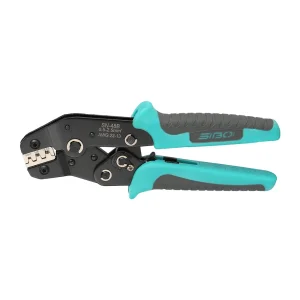
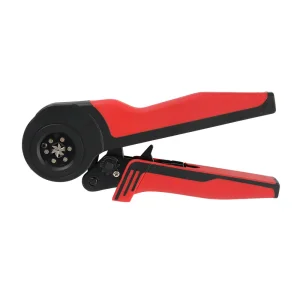
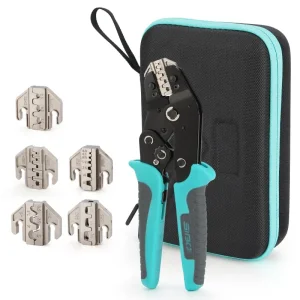
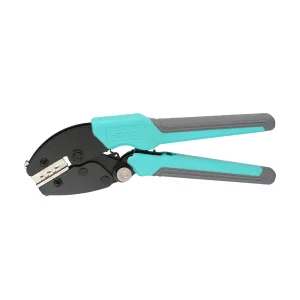
Engineered to eliminate operator error via calibrated micro-mechanisms, SIBO Tools Yueqing production line guarantees repeatable contact resistance across photovoltaic arrays, automotive wiring harnesses, and high-voltage switchgear.
The global market for electrical termination tools has transitioned decisively from simple manual plier grips to micro-engineered full-cycle ratchet mechanisms. In mission-critical environments—ranging from 1500V DC utility-scale solar photovoltaic farms to high-vibration e-mobility power distribution—cold-weld crimping integrity defines operational safety.
Traditional soldering introduces thermal embrittlement, flux corrosion, and toxic vapor hazards. Ratchet crimping yields a molecular-level cold deformation where copper strands and the connector sleeve fuse into a solid, gas-tight mass without solder flow.
International regulatory frameworks mandate strict pull-out force thresholds and contact resistance maximums (< 0.3 mΩ). Ratchet mechanisms physically lock until predetermined crimp-height closure is met, preventing catastrophic operator under-crimping.
As the capital of China's low-voltage electric industry, Yueqing produces over 65% of the world's commercial crimpers. Integrated supply ecosystems—from carbon steel drop-forging to vacuum heat treatment—deliver unmatched cost-to-precision ratios.
The physics of terminal crimping involves plastic deformation far exceeding the yield strength of both the electrical conductor and connector sleeve. SIBO Tools utilizes advanced tool-grade alloys and cam-leverage kinematics to achieve metallurgical compression without structural fracture.
The Cold-Welding Imperative: In high-amperage systems, microscopic voids within a crimp harbor oxygen, initiating galvanic corrosion and hot-spot arcing. A professional ratchet tool drives multi-directional compressive shear until the copper strands undergo mechanical plastic deformation, transforming stranded wires into a voidless, polygonal mass with 99.8% gas-tight contact.
Crimping jaw dies endure cyclical stresses exceeding 600 MPa. SIBO manufactures dies using high-chromium-molybdenum AISI 4140 alloy or Japanese SKD11 vacuum-hardened steel (58–62 HRC). Wire EDM cutting guarantees micro-tolerances within ±0.01 mm.
Our dual-fulcrum cam linkages amplify manual gripping force by a mechanical ratio of up to 1:28. This delivers over 1,200 kg of terminal compression force with less than 22 kg of human hand input, drastically reducing repetitive strain injuries (RSI).
Internal ratchet gears are calibrated via micro-eccentric adjustment wheels. If a terminal jams or an obstruction occurs, an integrated quick-release trigger safely disengages the mechanical pawl without destroying the tool frame.
| Series Code | Applicable Terminal Profile | Wire Gauge Capacity | Die Material | Crimping Geometry | Target Pull-Out Force |
|---|---|---|---|---|---|
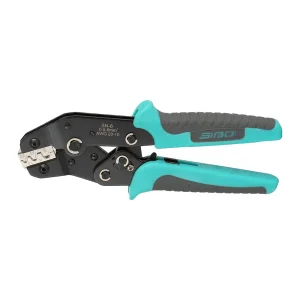
| SO-2546B Pro | MC4 Solar PV Connector Contacts | 2.5 / 4.0 / 6.0 mm² (AWG 14-10) | AISI 4140 Cr-Mo Alloy | Dual-Surface Hex-Roll | > 310 N (Exceeds IEC 62852) |
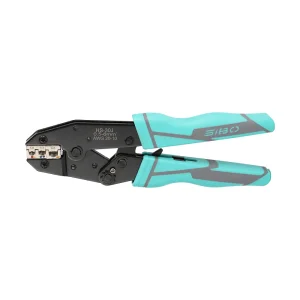
| SO-30J / 125 | Pre-Insulated Ring & Spade Lugs | 0.5 – 6.0 mm² (AWG 20-10) | Hardened Carbon Steel (HRC 50) | Oval & Sleeve Compression | > 250 N (UL 486A Compliant) |
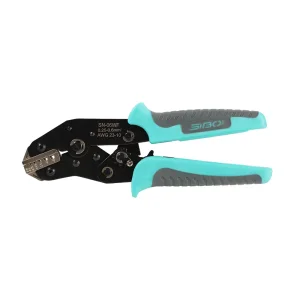
| SN-48B / SO-04B | Non-Insulated Open Barrel (Tab) | 0.14 – 1.5 mm² (AWG 26-16) | SKD11 High-Speed Steel | B-Crimp (Conductor & Sheath) | > 120 N (DIN EN 60352-2) |
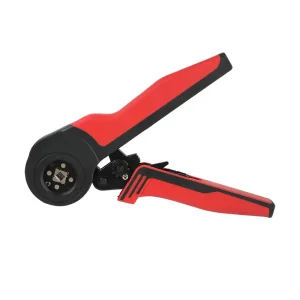
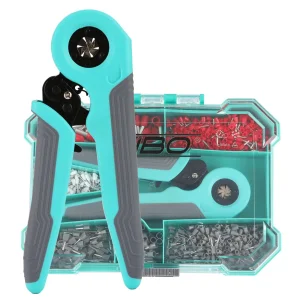
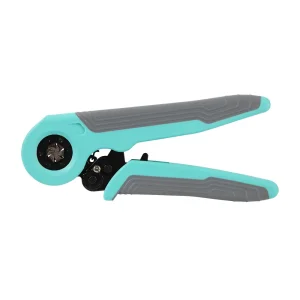
| SO 16-6 / 16-4 | Wire-End Ferrules (Bootlace) | 0.08 – 16.0 mm² (AWG 28-5) | S2 Alloy Tool Steel | Self-Adaptive Hex / Quad Indent | > 180 N (DIN 46228 Part 4) |
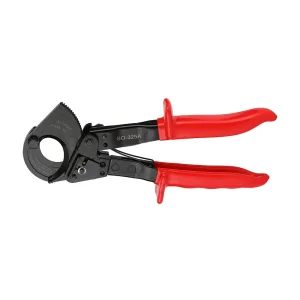
| FST-325A | Copper & Aluminum Heavy Feeder | Max 240 mm² Cable Shearing | Forged Manganese Blade | Progressive Ratchet Shearing | Clean Cut Without Wire Flaring |
From North American commercial microgrids to European rail transport and Asian consumer electronics assembly, SIBO ratchet tools are tailored to address environmental extremes, mechanical vibration, and stringent inspection regimes.
High ambient desert temperatures (+55°C) and continuous 1500V DC loads make poor crimps hazardous, creating arc fires. The SO-2546B Pro provides constant pin engagement, preserving string inverter efficiency.
High-current battery management system (BMS) lines and infotainment CAN-bus circuits require micro-crimping with open-barrel B-crimps (SN-48B) capable of withstanding heavy road vibrations without strand dislocation.
High-density push-in terminal blocks in automation enclosures necessitate hexagonal wire-end ferrules (SO 16-6), eliminating stray wire strands that cause short-circuits across adjacent terminal positions.
Extreme thermal cycling and salt-spray corrosion demand maximum barrel compression with thick-wall copper lugs. Heavy-duty tools like the SO-10 Pro prevent oxidative ingress under severe environmental stress.
As Industry 4.0 penetrates the hand tool ecosystem, manual tools are evolving to incorporate digital intelligence, advanced composites, and toolless modularity. SIBO Tools engineers are pioneering solutions that bridge traditional hardware and automated manufacturing workflows.
Integrating piezo-resistive pressure sensors within the cam fulcrum allows tracking of each crimp's pressure profile. Via Bluetooth BLE, operators log pull-force verification in real time, essential for ISO-certified aerospace compliance audits.
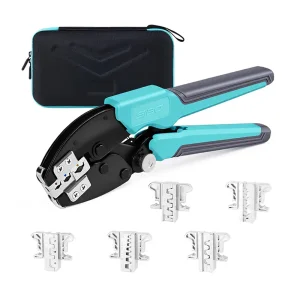
Transitioning from traditional slotted hex-screws to neodymium magnetic locators and detent ball pins allows technicians to switch between insulated, non-insulated, and solar connector dies in under 4 seconds without secondary screwdrivers.
Replacing heavy carbon steel handles with aviation-grade carbon-fiber reinforced polyamides reduces tool net weight by 38% while retaining tensile rigidity up to 850 MPa, addressing worker fatigue in continuous assembly plant lines.
Operating from Yueqing Sibo Tools Manufacture Co., Ltd., our industrial complex integrates complete vertical tool production: from CAD 3D simulation and die forging to CNC continuous-milling, automated laser etching, and tailored packaging.
Custom dual-injection TPR handle molds matched to Pantone color guides, fiber-laser engraved logo marks, bespoke retail blister packaging, and custom Oxford heavy-duty transport toolkits engineered for high-end international hardware distributors.
Have a proprietary connector geometry or non-standard terminal dimension? Our Yueqing engineering studio creates customized die tooling within 12 business days, verified with optical comparator coordinate measuring machines (CMM).
Every production batch undergoes destructive pull-testing (pull-off force tester), cross-section metallurgical polishing for microscopic void inspection, and continuous 5,000-cycle load endurance verification prior to shipping authorization.
Detailed technical responses to help professional buyers, sourcing managers, and electrical engineers evaluate die profiles, ratchet mechanics, pull-out thresholds, and OEM manufacturing agreements.
Non-ratchet plier tools rely purely on human grip strength, which inevitably results in inconsistent compression, fatigue, and severe under-crimping. In contrast, a ratchet crimping tool features an internal gear and spring-loaded pawl that locks the handles until the dies close completely to a predetermined height, ensuring every single crimp satisfies gas-tight DIN/IEC standards.
Solar photovoltaic installations operate at voltages up to 1500V DC and currents exceeding 30A. A loose crimp generates microscopic electrical arcing, which escalates thermal resistance beyond 105°C, creating catastrophic fires. The SIBO SO-2546B Pro series enforces an exact crimp height on 2.5, 4.0, and 6.0 mm² cables, keeping joint resistance below 0.2 mΩ.
Self-adjusting tools (such as SIBO SO 16-6 and SO 16-4) use a floating multi-segment concentric cam mechanism. When handles are compressed, four or six synchronized die jaws advance uniformly toward the tool axis, automatically accommodating whatever cross-section of wire and ferrule is present (from 0.08 mm² to 16 mm²) without requiring manual die cavity selection.
All professional SIBO ratchet tools are engineered with an integrated emergency release lever (pawl disengagement trigger). Located between the interior handle pivot, this lever can be tripped with a flat screwdriver or manual thumb push to reverse the ratchet gear, releasing the jammed workpiece without cracking the jaw dies or bending the steel frame.
For standard tool chassis with custom two-tone handle colors, laser-etched brand logos, and printed retail blister packs, our standard factory MOQ starts at 500 units with a 25-day production cycle. For fully bespoke die design or new handle tool forging, tooling lead time is approximately 15 to 20 days, followed by sample verification.
Review the second half of SIBO's industrial tool lineup, encompassing miniature European wire-end ferrule crimpers, modular magnetic jaw kits, and self-adaptive industrial wire harnessing systems.