Calibrated full-cycle ratchet mechanisms, specialized terminal cavities, and ergonomic high-leverage dies ensuring gas-tight compression across heavy-duty electrical architectures.
Navigating hazardous substance thresholds, supply chain cross-contamination risks, and total cost of ownership (TCO) across multinational electrical engineering operations.
In the contemporary electrical equipment and wiring harness sector, compliance with environmental mandates is no longer an afterthought confined to passive components or bare copper conductors. International procurement directors at Fortune 500 equipment integrators, Tier-1 automotive harness manufacturers, and solar utility EPCs face stringent statutory oversight under the European Union RoHS Directive 2011/65/EU and its delegated directive (EU) 2015/863 (RoHS 3), along with corresponding regulatory frameworks across North America, Japan, and South Korea. This demands that every tool utilized in the assembly, crimping, and maintenance cycle complies with substance limits, completely eradicating lead (Pb), cadmium (Cd), hexavalent chromium (Cr VI), mercury (Hg), polybrominated biphenyls (PBB), polybrominated diphenyl ethers (PBDE), and restricted phthalates (DEHP, BBP, DBP, DIBP).
The operational vulnerability identified by supply chain quality auditors is indirect chemical cross-contamination. Conventional low-cost crimpers frequently utilize cheap secondary plasticizers in dual-component TPR/PVC handle grips and contaminated heavy-metal corrosion-inhibiting baths for steel jaws. During high-intensity terminal termination, micro-abrasions release forbidden chemical agents onto the terminal barrel, terminal insulation sleeve, or conductor strand bundle. Under elevated operational thermal cycles (such as 105°C to 125°C automotive conditions), these migrated phthalates accelerate plasticizer migration, inducing premature terminal insulation embrittlement, dielectric breakdown, or failure during downstream X-Ray Fluorescence (XRF) and gas chromatography mass spectrometry (GC-MS) sweeps.
Strict elimination of hazardous trace elements through metallurgical spectroscopic batch testing, safeguarding cleanrooms and medical wiring lines from lead or cadmium leaching.
Eliminating operator variability through calibrated micro-ratchet mechanisms that will not disengage prematurely until the exact terminal yield pressure is reached.
Evaluating hand tooling procurement on a cost-per-crimp basis rather than initial acquisition cost, drastically curbing field failure downtime and assembly rework.
From multi-megawatt utility photovoltaic arrays to mission-critical aerospace telemetry harnesses, examine how tailored crimp geometries achieve permanent mechanical and electrical continuity.
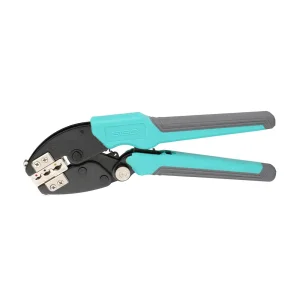
Utility-scale solar farms demand high-current contact integrity. SIBO's SO-2546 Pro series delivers precision B-crimps on MC4-compatible 2.5mm², 4mm², and 6mm² PV cables, preventing hotspot arcing across 1500V DC strings.
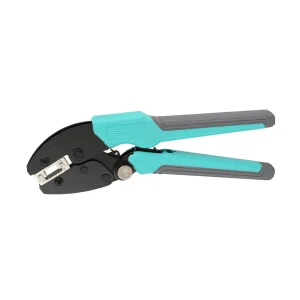
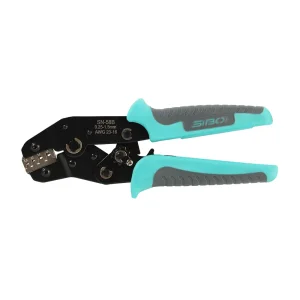
Automotive electrical distribution boxes require high-density terminations under intense vibration. Open-barrel ratcheting tools (such as the SO-04BPro and SN-58B) roll wire tabs into an airtight, gas-tight cold weld joint.
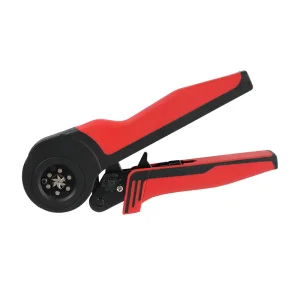
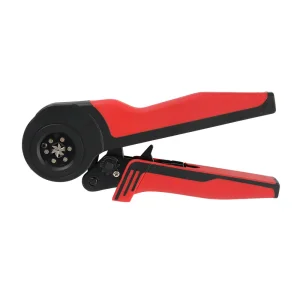
Industrial PLC cabinets rely on tubular wire-end ferrules to prevent fraying inside push-in terminal blocks. Our SO 16-6 and SO 10-4 self-adjusting hexagonal and square crimpers provide uniform 360-degree radial pressure.
High-frequency data communication infrastructure cannot tolerate impedance mismatches caused by inconsistent crimp heights. SIBO's precision non-insulated tools deliver calibrated micro-indentation on delicate telemetry wiring.
| Tool Series | Target Terminal Architecture | Wire Gauge Range (AWG / mm²) | Crimp Profile Geometry | Compliance & Quality Norms |
|---|---|---|---|---|
| SO-30J Pro Series | Pre-Insulated Terminals (Red, Blue, Yellow) | AWG 22-10 / 0.5 - 6.0 mm² | Oval & Double-Pressure Crimp | RoHS 2.0, CE, UL 486A-B, IEC 60352-2 |
| SO-056FL-Pro | Flag Terminals & Non-Insulated Lugs | AWG 20-10 / 0.5 - 6.0 mm² | Asymmetrical Notch Indent | RoHS 2.0, REACH, ISO 9001:2015 |
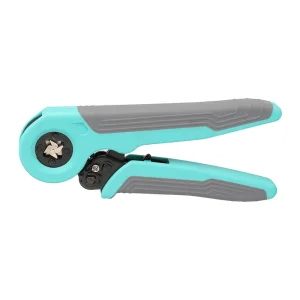
| SO-16-6 Adjustable | End Sleeves / Wire-End Ferrules | AWG 28-5 / 0.08 - 16.0 mm² | Self-Regulating Hexagonal | DIN 46228 Part 1 & 4, RoHS 2.0 |
| SO-2546C Pro | Solar PV MC4 Photovoltaic Contacts | AWG 14-10 / 2.5 - 6.0 mm² | High-Density Stepped B-Crimp | TÜV Rheinland, UL 6703, RoHS 2.0 |
| SN-58B Series | Micro Open-Barrel (Dupont, JST, Molex) | AWG 28-18 / 0.08 - 1.0 mm² | Micro-Roll Dual-Zone Tab Crimp | IPC/WHMA-A-620 Standard, RoHS 2.0 |
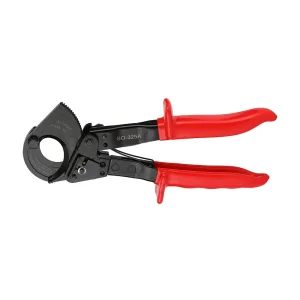
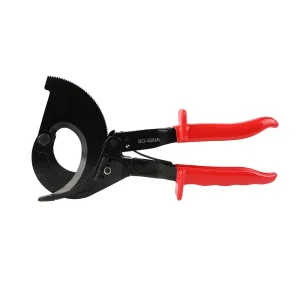
| FST-520A Heavy Ratchet | Copper & Aluminum Power Cables | Up to 400 mm² Cable Outer Diameters | Scissor Shear (Clean Non-Crush) | RoHS 2.0, EN 60900 Industrial Standard |
An inside exploration of alloy selection, vacuum induction heat treatment, Wire EDM micro-cavity fabrication, and force multiplication kinematics at our Yueqing production center.
The lifespan and repeatable precision of an industrial crimping tool are fundamentally governed by two criteria: die cavity metallurgy and linkage kinematics. At Yueqing Sibo Tools Manufacture Co., Ltd., we maintain zero tolerance for standard low-carbon stamped sheet metal. Every structural component in our Pro and heavy-duty series undergoes rigorous thermodynamic simulation and physical batch testing to guarantee elastic resilience under peak mechanical yield stress.
Our crimper frames and primary stress jaws are hot-forged and precision-stamped from premium AISI 4140 Chromium-Molybdenum Alloy Tool Steel or high-grade 50CrV4 spring alloy. Unlike standard carbon steel, which suffers plastic deformation after 5,000 cycles, 4140 alloy steel possesses an ultimate tensile strength exceeding 1,000 MPa following multi-stage vacuum heat treatment. The working cavities of our dies are processed through precision Wire Electrical Discharge Machining (Wire EDM) utilizing sub-micron copper electrodes. This yields complex terminal crimping profiles with dimensional surface tolerances within ±0.005mm and a mirror finish that prevents terminal plating galling, copper swarf buildup, and premature die wear.
Dies are heat-treated in computer-controlled vacuum furnaces, achieving a localized surface hardness of HRC 58 to 62. This imparts exceptional resistance to abrasion while maintaining an elastic core toughness that prevents brittle fracture under unexpected overload.
Our transmission levers utilize an optimized mathematical pivot ratio that reduces required manual hand force by 32% to 45% compared to traditional direct-lever pliers. Operators achieve full-cycle terminal compaction with smooth, fatigue-free continuous motion.
Integrated eccentric gear discs allow calibration technicians to compensate for slight mechanical bedding over tens of thousands of cycles. A simple dial adjustment recalibrates factory crimping pressure without replacing the tool body.
Why international tool brands and procurement consortia are consolidating their hand tool supply chain directly in Yueqing, Zhejiang, bypassing fragmented middlemen.
The global hand tool market has experienced substantial geopolitical and economic shifts over the past decade. While discussions of supply chain regionalization and nearshoring have gained prominence, the specialized hardware tool industry—specifically precision electrical crimping pliers and cable cutters—remains heavily concentrated in the industrial cluster of Yueqing, Zhejiang Province, China.
Yueqing is globally renowned as the manufacturing capital of low-voltage electrical apparatus. This geographic ecosystem provides unparalleled supply chain density: alloy steel suppliers, specialized surface treatment and environmentally compliant electroplating facilities, plastic mold injection houses, CNC machining centers, and electrical testing laboratories operate within a 15-kilometer radius. For international buyers, partnering with an established manufacturer like Yueqing Sibo Tools Manufacture Co., Ltd. provides an agile manufacturing framework that no Western private label or decentralized overseas factory can replicate.
From custom die prototype modeling to progressive stamping, vacuum quenching, surface phosphating, dual-color handle molding, and final ratchet calibration, all steps occur under our direct quality control umbrella.
When our OEM partners identify emerging connector pin standards (such as new electric vehicle battery sensor lugs or specialized solar connectors), our engineering department delivers functional production-grade prototypes within 14 business days.
We empower global brand owners with extensive private labeling solutions: laser-etched brand identities, pantone-matched handle grips, bespoke multi-die Oxford bag combinations, and retail-ready blister or rigid packaging.
Every batch of SIBO crimping tools undergoes rigorous mechanical tensile validation, cross-sectional metallography, and corrosion resistance screening prior to export dispatch.
Crimped samples are clamped into computerized motorized tensile testers to measure break-away and pull-off force, guaranteeing that mechanical tensile retention exceeds the thresholds defined by UL 486A-B and IEC 60352-2.
Sample wire crimp terminations are sliced, polished, and chemically etched to inspect internal strand deformation under high-magnification microscopes, verifying the total elimination of voids and a gas-tight, cold-welded cross section.
Steel assemblies, release levers, and dies are subjected to 48-to-96-hour neutral salt spray (NSS) corrosion testing to verify that black oxide, zinc phosphate, or electroless nickel coatings resist harsh offshore and tropical environments.
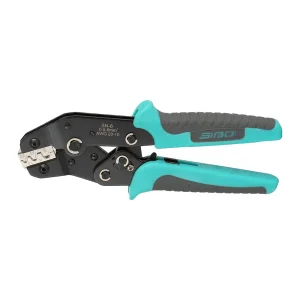
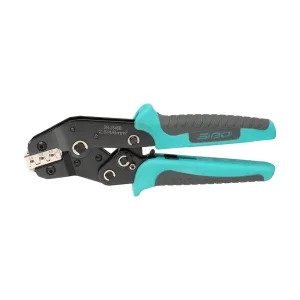
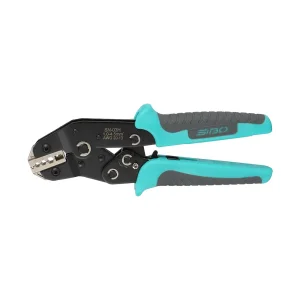
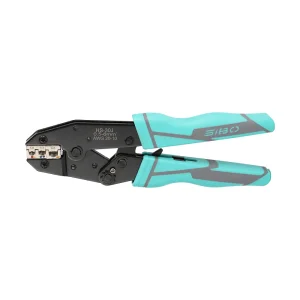
Complete your equipment line with our European-style mini pliers, adjustable self-regulating ferrule crimpers, and specialized non-insulated terminal tooling.
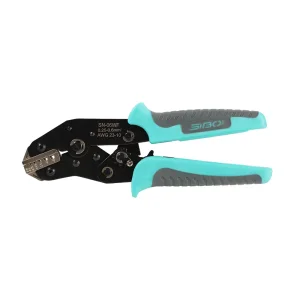
Definitive technical guidance for electrical engineers, tooling distributors, and procurement directors sourcing crimping tools from China.
Connect with our senior tool design engineers in Yueqing to review terminal samples, request digital CAD models, or configure tailored OEM tooling kits for your distribution network.
