
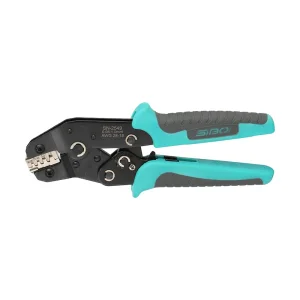
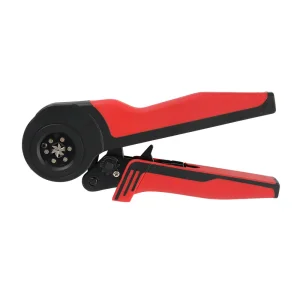
China Suppliers Factory Crimping Pliers for Standard Non-Insulated Terminals - Ring, Spade, Fork & Butt Connectors
Access Technical Spec
Engineered for high-volume electrical infrastructure, PV utility installation, and industrial cable harness assembly.
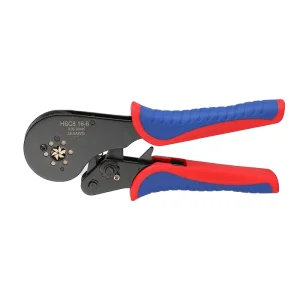
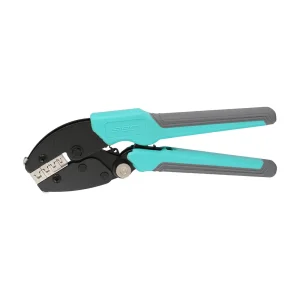
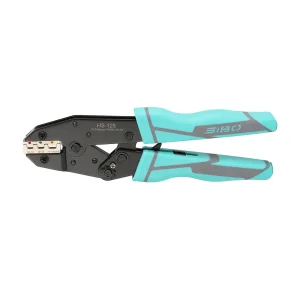
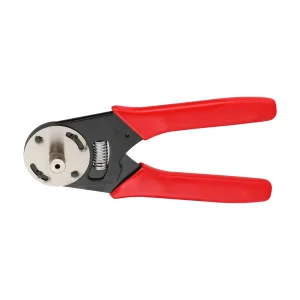
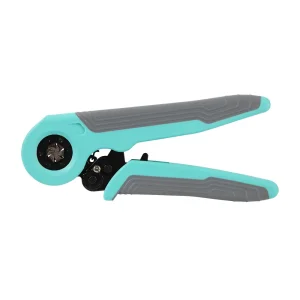
The global solar energy paradigm is transitioning rapidly toward 1500V DC topologies, bifacial utility architectures, and extreme atmospheric operating parameters. Tooling compliance is no longer optional—it governs bankability.
Higher DC line voltages demand gas-tight crimp profiles. Incomplete compression induces contact resistance, thermal expansion cycles, and catastrophic direct-current arcing faults in ground-mounted utility arrays.
Global institutional insurers and asset managers require verified pull-out force metrics that conform to IEC 60352-2 and UL 486A/B, mandating calibrated, cycle-locked ratchet mechanisms that eliminate manual operator error.
Field engineering now spans from standard 2.5mm² rooftop installations to heavy 10mm² tracker leads. Modern hand tools must deliver rapid modular jaw swaps without degrading structural calibration.
Procuring solar crimpers from China requires moving beyond base pricing to evaluate metallurgical stability, mechanical longevity, and supply chain transparency.
Tooling must reliably compact copper strands to exceed 310N tensile pull-out strength for 4mm² and 360N for 6mm² cross-sections, preventing mechanical displacement under continuous thermal expansion.
Improper crimp geometries leave micro-voids between strands, raising micro-Ohm values. Premium die profiles deliver cold-welded copper matrices that prevent hot-spot degradation and yield loss.
Field installers perform thousands of crimp operations per megawatt block. Lever transmission ratios must keep grip force under 250N while maintaining complete ratchet cycle completion.
Distributors require tailored handle mouldings, durable laser-etched cavity legends, custom-cut foam inserts, and matched combination sets designed around their preferred contact geometries.
A safe solar installation requires more than just hand tools. It depends on a coordinated workflow that covers precision wire peeling, balanced cutting, calibrated compression, and verified connector assembly.
Proper contact alignment begins with clean wire preparation. Our stripping systems slice cross-linked polyethylene (XLPO) dual jackets cleanly, preventing core strand nicking and keeping the active copper section intact.
Our EDM wire-cut jaws roll open-barrel solar contact wings smoothly into the conductor bundle. This produces a dense, void-free cross-section with high tensile retention and low contact resistance.
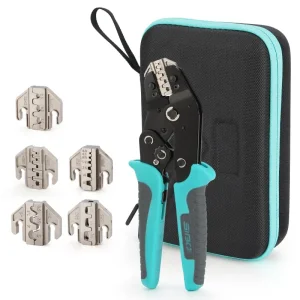
We configure turnkey kits in rugged Oxford textile bags, pairing our ratchet crimpers with high-leverage shears, dual-jaw solar strippers, and specialized plastic disconnect/tightening spanners.
Tool performance begins with metallurgy. We stamp our jaw frames from high-strength carbon steel, mill our dies using slow-wire EDM for micron tolerances, and finish with controlled carburizing heat treatments. This yields a surface hardness of HRC 42-45 across the chassis and HRC 58-62 on the crimping faces—ensuring stable calibration well past 30,000 continuous compression cycles.
Our Yueqing production facility integrates progressive metal stamping, CNC wire machining, and calibrated pull-out force testing under a unified ISO 9001:2015 quality framework.
Every tool design undergoes third-party pull-force testing to satisfy IEC 60352-2 and UL 486A/B requirements. Low contact resistance is documented across 2.5, 4.0, and 6.0 mm² PV cables.
We work with brand owners and distributors across North America, Europe, and the APAC region to deliver custom dual-injection handle grips, custom surface finishes, and export-ready packaging.
Based in Yueqing, Zhejiang—China’s low-voltage electrical capital—we provide rapid sea freight dispatch through Ningbo and Shanghai ports, backed by responsive engineering support.
As PV utility balance-of-system designs shift toward larger DC cross-sections and automated verification, we continue to upgrade our tool architectures.
Developing push-button quick-change retention dies that let field technicians swap between standard MC4, MC4-EVO2, and ferrule jaw sets in seconds without allen keys.
Applying physical vapor deposition (PVD) titanium coatings to die surfaces to decrease friction, stop pin sticking, and extend die life beyond 50,000 cycles.
Integrating micro-pressure transducers into tool handles to log completed crimp cycles and confirm proper closure force via wireless interfaces on commercial jobsites.
Designing high-leverage planetary ratchet mechanisms to crimp large-diameter tracker cables cleanly without exceeding safe manual hand-grip forces.
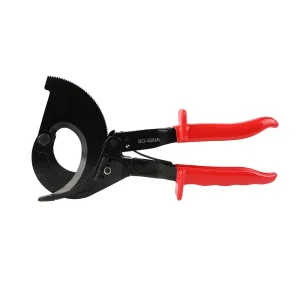
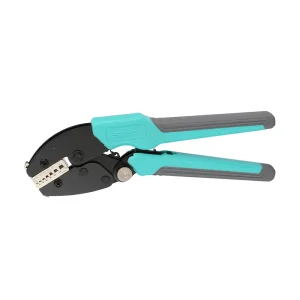
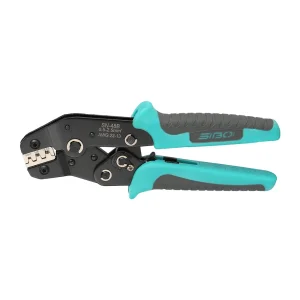
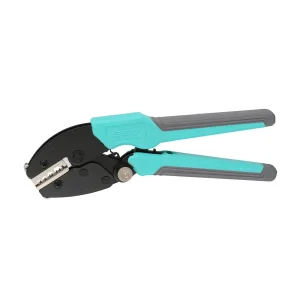
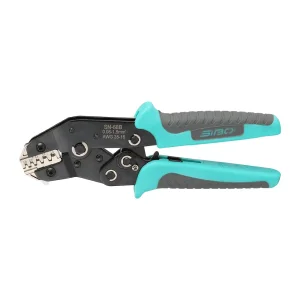
Our complete range of ratchet tools, open-barrel crimpers, and heavy-duty cutters built to handle daily industrial use.
Our sales and application engineers address the most common technical questions asked by EPC contractors, wholesalers, and private-label buyers.