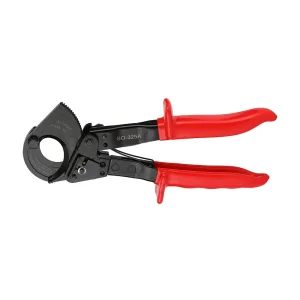
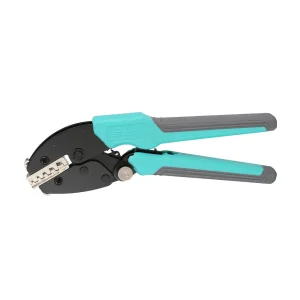
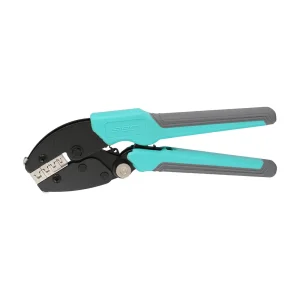
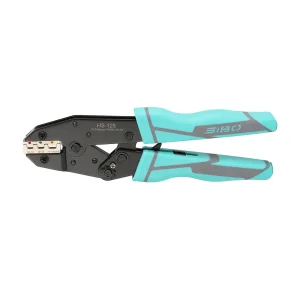
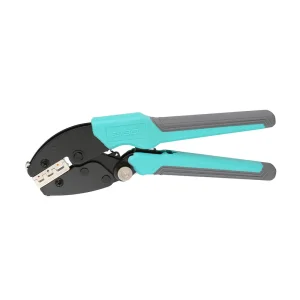
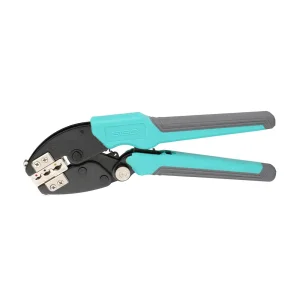
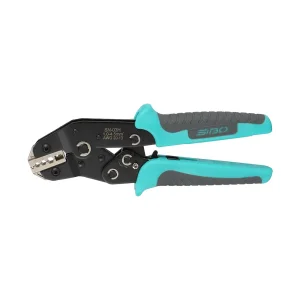
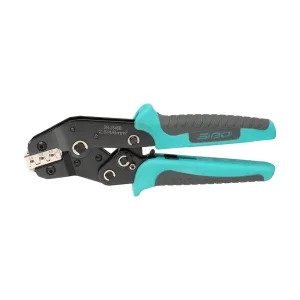
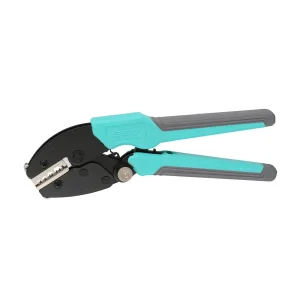
Direct-from-factory hand, ratchet, and modular benchtop tools manufactured in Yueqing under rigorous ISO 9001 and CE quality guidelines.
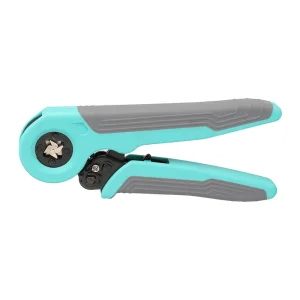
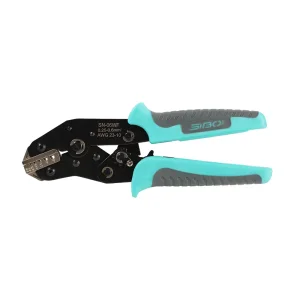
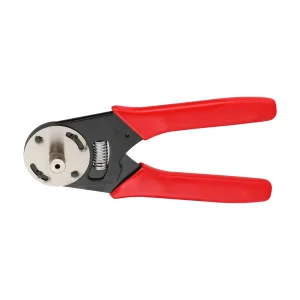
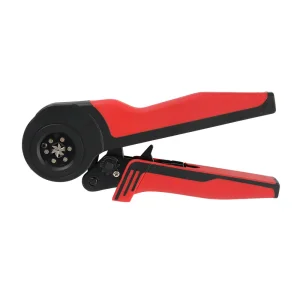
Achieving zero-defect gas-tight electrical terminations through precise crimp height tolerance, terminal compaction dynamics, and controlled metallographic plastic deformation.
High-reliability crimp connections are governed by cross-sectional compaction dynamics. Industrial crimping presses apply compressive force within engineered die contours to transform individual multi-strand copper cores and terminal copper sleeves into a unified, voidless metal polygon (hexagonal, B-crimp, or indent style).
By reducing inner interstitial air pockets to under 5% of cross-sectional area, oxidation ingress is mechanically blocked, maintaining electrical contact resistance in micro-ohm regions under extreme temperature cyclic variations (-40°C to +125°C).
Custom crimping press manufacturers engineer structural rigidities utilizing heavy cast-iron or stress-relieved high-tensile structural steel frames. Tool deflection during stroke cresting directly corrupts crimp height uniformity.
Benchtop presses engineered by top Chinese tooling factories maintain upper-to-lower ram parallelism deflection within ±0.015 mm under rated tonnage loads (typically 1.5T to 30T). This delivers tight mechanical reproducibility across hundreds of thousands of cycles without cumulative metallurgical fatigue.
Modern manufacturing protocols require inline process control via piezoelectric quartz sensors integrated into the press ram. Force-displacement signatures are sampled at high frequencies (up to 10 kHz) to detect missing wire strands, improper strip lengths, terminal gauge variances, or damaged connector insulation sleeves before downstream assembly.
Automated ejection gates trigger instant lockouts when force profiles breach upper or lower control thresholds, guaranteeing statistical capability (Cpk ≥ 1.67) according to IPC/WHMA-A-620 standards.
| Wire Gauge (AWG / mm²) | UL 486A Pull-Out Force (Min. N) | IEC 60352-2 Tensile Threshold (N) | Target Crimp Height Tolerance | Optimal Compaction Rate (%) |
|---|---|---|---|---|
| 26 AWG / 0.14 mm² | 18 N | 15 N | ±0.015 mm | 80% – 85% |
| 20 AWG / 0.50 mm² | 58 N | 50 N | ±0.020 mm | 82% – 88% |
| 16 AWG / 1.50 mm² | 133 N | 150 N | ±0.025 mm | 84% – 90% |
| 10 AWG / 6.00 mm² | 356 N | 360 N | ±0.035 mm | 85% – 92% |
| 4 AWG / 25.0 mm² | 890 N | 900 N | ±0.050 mm | 87% – 94% |
From metallurgical alloy supply chains to sub-micron wire EDM finishing, Yueqing stands as the epicenter of electrical connector and termination tooling manufacturing.
Custom crimp tooling demands specialized alloys such as Cr12MoV, DC53, SKD11, and high-speed tungsten carbide inserts. The industrial ecosystem surrounding Yueqing allows tooling factories to procure vacuum-degassed tool steels within 2-hour logistics windows.
In-house vacuum heat treatment chambers achieve repeatable surface hardnesses of HRC 60–62 with cryogenic tempering (-196°C) to eliminate residual austenite, virtually eliminating jaw chipping even after hundreds of thousands of cycles.
Modern crimp die geometries require complex profiles with precision lead-in chamfers, bellmouth radius transitions, and micro-serrations. Factories deploy high-speed slow-feeding wire electrical discharge machining (WEDM) delivering contour accuracies down to ±0.002 mm with surface roughness Ra ≤ 0.2 μm.
These ultra-smooth die cavities reduce galling and brass tin plating pickup, lowering connector wear and extending maintenance intervals across high-speed automatic lines.
Western tooling lead times often stretch between 12 to 24 weeks for bespoke die configurations. Chinese manufacturers leverage agile rapid prototyping cycles, validating new terminal die geometries via finite element analysis (FEA) and delivering precision pilot samples in as little as 10 to 14 business days.
This rapid iteration speed allows global tier-1 automotive, telecom, and solar OEMs to synchronize tooling readiness directly with tight vehicle or device launch milestones.
What engineering directors, quality managers, and global procurement teams scrutinize before selecting an OEM/ODM crimping press partner.
Procurement engineers require compliance verification under international testing criteria, including UL 486A-B, IEC 60352-2, and DIN EN 60352. Tensile testing verifies that crimped joints do not suffer conductor slip, necking, or core rupture under standard pull rates (typically 25 mm/min to 50 mm/min).
Factories provide authenticated tensile test logs and cross-sectional micrographic images with every custom die calibration, documenting exact retention values alongside terminal metal specifications.
Evaluating joint reliability extends far beyond external visual appearance. Certified labs perform metallographic destructive cross-section cutting, fine grinding, diamond polishing, and chemical etching.
High-magnification optical microscopes check crimp wing symmetry, serration penetration depths, strand compaction distribution, and copper-to-brass interface fusion. This confirms absence of burrs, flash, bottom cracks, or over-crimped insulation that could lead to insulation breakdown.
Tier-1 harness manufacturers mandate adherence to environmental and mechanical safety directives. Production machinery must comply with CE Machinery Directives (2006/42/EC), Low Voltage Directive (2014/35/EU), and Electromagnetic Compatibility (2014/30/EU).
Tools and terminal components undergo strict heavy-metal chemical testing to satisfy EU RoHS and REACH regulations, protecting both field operators and end-of-life recycling compliance.
Custom crimping equipment deployed across diverse high-vibration, high-current, and hostile industrial operating environments.
High-voltage battery packs, onboard inverters, and charging harnesses in 800V architectures handle currents up to 400A. Equipment utilizes hex or double-indent dies with hydraulic stroke modulation to prevent terminal embrittlement on fine multi-strand silicone conductors.
Utility-scale solar farms require field connections capable of enduring 30+ years of UV exposure and thermal expansion. Our SO-2546 and SN-2546B series tools crimp MC4-type stamped-and-formed and machined pin contacts to DIN EN 50521 standards.
Control cabinet builders manage dense terminal blocks demanding DIN 46228 end ferrules. Self-adjusting square and hexagonal crimpers (such as the SO 10-4 and SO 16-6 series) ensure balanced insertion into spring-clamp or screw terminals without wire fraying.
Closed-barrel contact terminations in high-vibration aerospace and railway rolling stock mandate precise 4-indent / 8-impression crimping tools according to MIL-DTL-22520 standards, preventing pin fatigue under continuous shock conditions.
How IoT intelligence, AI visual verification, and servo-electric kinematics are reshaping the wire processing landscape.
Traditional mechanical flywheels and pneumatic cylinders are being superseded by brushless servo-driven direct electric actuators. These systems deliver fully programmable ram acceleration profiles, dwell times at bottom-dead-center (BDC), and micrometer-precise stroke depth adjustments (±0.001 mm).
Energy consumption is cut by up to 60%, pneumatic oil mist emissions are eliminated in cleanroom electronics facilities, and noise levels drop below 65 dB(A).
High-speed machine vision cameras integrated inside the crimp station capture 360-degree telecentric images of every crimped termination in under 80 milliseconds. Convolutional neural networks evaluate brush protrusion lengths, insulation gap compliance, cut-off tab dimensions, and terminal roll symmetries.
Automated defect classification flags process drift before whole harness sub-assemblies are processed, drastically reducing scrap rates in automotive assembly plants.
Tooling die blocks embedded with passive RFID chips and cycle counters track accumulated hits in real-time. Maintenance thresholds push automated alerts to factory ERP systems before tool steel degradation alters crimp geometry.
Global brands can monitor tooling inventory across multiple outsourced tier-2 processing plants, ensuring global standardization and uniform termination quality.
Answers from our senior die tooling engineers covering calibration, die metallurgy, validation protocols, and custom OEM ordering parameters.
Advanced industrial crimpers for solar photovoltaic systems, high-torque non-insulated lugs, and custom terminal combinations.
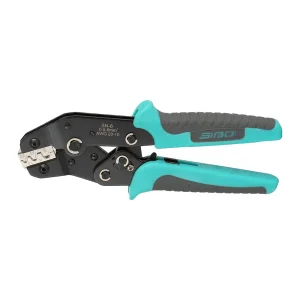
Work directly with Yueqing Sibo Tools' senior tooling engineers. We provide CAD die profiling, tensile verification, and microsection cross-sectional validation before series manufacturing. Connect with our technical sales division for swift quotations and sample validation.