Explore our top-tier precision crimping instruments built with hardened alloy jaws, progressive micro-adjustment gears, and calibrated automatic release mechanisms.
From thermal soldering hazards to cold radial compression: Why critical infrastructure across HVAC, automotive harnesses, and multi-layer piping mandates certified mechanical crimping.
In modern industrial fluid networks, district heating installations, hydronic underfloor heating, and mission-critical electrical distribution boards, mechanical joint integrity has evolved from an empirical assembly craft into an exact science of metallographic plastic deformation. Historically, plumbing and electrical infrastructure relied extensively on high-heat brazing, chemical solvent welding, or manual screw-down clamps. However, structural liabilities—such as micro-void inclusion, heat-affected zone (HAZ) annealing, thermal stress embrittlement, and human operator torque variability—have triggered an uncompromising industry-wide transition toward radial cold-press crimping systems.
Today's international building codes (such as EN ISO 21003 for multi-layer PEX-AL-PEX pipe systems and ASTM F1807 / ASTM F2159 for cross-linked polyethylene tubing), combined with international electrotechnical regulations (DIN EN 60352-2 and UL 486A-486B), require uniform radial compressive forces. A professional pipe or cable crimping tool is no longer merely a hand tool; it is a precision-calibrated mechanical press. Engineering procurement managers and global distributors face stringent requirements: tools must deliver repeatable dimensional compaction, minimize interstitial void ratios down to below 5%, prevent seasonal galvanic corrosion, and resist hydrodynamic pressure surges exceeding 40 bar.
Technical Core Insight: A laboratory-grade crimp creates a homogeneous, gas-tight cold weld between the compression sleeve, the pipe substrate (or wire strands), and the core connector. This micro-mechanical interlocking maintains elasticity under continuous cyclic thermal shock ranging from -40°C to +125°C, completely eliminating creep and flow leakage.
Global adoption of composite PEX-AL-PEX and stainless steel press-fit plumbing is expanding at 7.8% CAGR. Installers demand lightweight, compact press tools with quick-interchangeable TH, U, V, and M profile jaws that guarantee 100% leak-proof verification without open flames.
Electric vehicle (EV) battery packs and fast-charging stations incorporate dense networks of aluminum-plastic cooling pipes and high-voltage shielded copper cables. Precision radial crimpers eliminate contact resistance spikes and ensure liquid coolant hermetic sealing under heavy vehicle vibration.
Large infrastructure developers require tools engineered with full-cycle ratchet interlocks, micro-switch wear indicators, and certified die geometries that prevent operator-induced partial crimps and pass third-party pull-force and hydrostatic burst tests.
How Yueqing Sibo Tools leverages end-to-end industrial integration, robotic CNC machining, and metallurgical heat-treatment mastery to deliver cost leadership without quality compromise.
Located in Yueqing, Zhejiang Province—the internationally recognized hub of low-voltage electrical apparatus and precision metal forming—SIBO Tools manufactures over 3 million hand and hydraulic crimping units annually. The Yueqing industrial ecosystem offers an unmatched supply chain density: specialized alloy steel stockists, high-precision slow-wire electrical discharge machining (WEDM) specialists, optical mold engravers, and automated surface finishing centers all operate within a 15-kilometer radius. This geographic concentration gives our factory immediate agile adaptability, collapsing custom mold tooling cycles from the Western industry standard of 60 days down to just 10 working days.
Our smart manufacturing facility integrates automated five-axis CNC machining centers, robotic stamping lines, and atmospheric vacuum carburizing furnaces. Rather than outsourcing critical process steps, SIBO maintains 100% in-house control over the core metallurgical lifespan of our crimping jaws. Tool frames are stamped from heavy-gauge cold-rolled carbon steel, while crimping dies are forged from vacuum-degassed Cr12MoV or 42CrMo alloy tool steel, quenched and tempered to Rockwell Hardness HRC 58-62. This prevents dimensional wallout and jaw flaring even after 30,000 continuous compression cycles under maximum rated mechanical tonnage.
Every newly designed jaw profile and multi-link mechanical toggle lever undergoes structural FEA stress-distribution simulation to prevent localized stress concentrations and eliminate handle flexure during peak radial clamping loads.
Dies receive computerized multi-stage vacuum oil quenching and double tempering cycles. High-friction pivots and internal teeth are treated with corrosion-resistant black oxide, manganese phosphating, or electropolished chrome plating.
Production samples undergo micro-cutting, diamond polishing, and chemical etching to verify microscopic copper compaction, wall thickness symmetry, absence of flash burrs, and compliance with pull-out tensile break forces.
An authoritative engineering breakdown of compressive mechanical kinematics, die profile geometry tolerances, and international pull-off validation matrices.
The science of pipe and cable crimping relies on controlled cold work deformation. When mechanical force is applied via the lever arm to the crimp sleeve, the metal passes through three distinct physical stages: elastic displacement, plastic deformation, and permanent molecular compaction. In pipe crimping (such as PEX-AL-PEX brass fittings or stainless steel press couplings), the crimper must exert multi-directional radial force that compresses the outer metal sleeve inward, permanently locking the intermediate plastic pipe layers against the barbed inner fitting core with zero elastomer seal extrusion.
In wire terminal crimping (such as insulated lugs, uninsulated ring tongues, and open-barrel automotive terminals), the goal is to deform individual copper strands until they lose their round cross-sections and form a hexagonal, diamond, or B-type consolidated honeycomb mass. If the crimp height (CH) is too high (under-crimping), air gaps remain inside the joint, promoting atmospheric oxidation, elevated micro-ohmic electrical resistance, thermal hotspots, and eventual fire hazards. Conversely, if the crimp height is too low (over-crimping), the die severely notches the conductor strands or fractures the copper wall, drastically degrading the mechanical tensile retention strength.
| Crimping Category | Applicable Standards | Optimal Crimp Geometry | Target Substrates | Tensile Pull / Hydrostatic Metric |
|---|---|---|---|---|
| PEX / Multilayer Pipe | ASTM F1807 / EN ISO 21003 | Radial Hexagonal / U / TH / V Profile | Copper, Brass, Stainless, Aluminum | Hydrostatic burst pressure > 35 - 45 Bar |
| Open-Barrel Terminals | DIN EN 60352-2 / SAE AS7928 | F-Crimp / B-Crimp Dual-Arch Rolling | Stranded Copper / Brass Contacts | Min. 120N (0.75mm²) to 450N (6.0mm²) |
| Insulated Terminal Lugs | UL 486A-486B / CSA C22.2 | Color-Coded Oval Compaction | Tin-Plated Copper + PVC/Nylon Sleeves | Retention pull force exceeding UL test threshold |
| Wire-End Ferrules | DIN 46228 Part 1 & 4 | Self-Adjusting Hexagonal / Square | Fine-Stranded Flexible Wires | 100% elimination of stray loose wire ends |
| Solar Photovoltaic PV | IEC 62852 / UL 6703 | Precision Nested Locator Die (MC4) | Tinned Multicore Solar Cable (2.5-6mm²) | Contact resistance < 0.25 mΩ, pull-force > 310N |
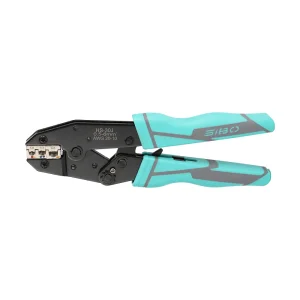
A frequent failure mode observed in low-budget manual crimping tools is premature release by the installer under fatigue. Yueqing Sibo Tools solves this through our hardened internal carbon-steel ratchet interlock. The jaw carrier will not release its grip under any circumstance until the handle travel passes the exact mechanical dead center point, ensuring 100% complete cycle closure every single press. For field safety or accidental wire mismatch, an accessible emergency manual release lever is integrated, allowing instant jaw clearance without damaging the tool chassis.
How tier-one tool distributors, hardware retail chains, and international electrical brands partner with SIBO Tools to configure custom-branded tooling portfolios.
Provide your technical drawing, terminal contact samples, or pipe sleeve dimensions. Our engineering team calculates clearance ratios, machines prototype EDM test dies in 72 hours, and performs metallographic micro-sectioning to validate the die cavity prior to mass production.
Ergonomic non-slip handles molded from dual-component TPR/PP compound in your brand's specific Pantone color codes. We offer high-definition fiber laser marking of logos, part numbers, and AWG/metric wire conversion tables directly on the tool bodies.
From heavy-duty high-density 600D Oxford fabric storage pouches to blow-molded custom carry cases equipped with multi-cavity die sets, terminal assortments, and integrated precision cable cutters, we deliver shelf-ready packaging for global retail and industrial distribution.
In wholesale tool procurement, selecting lowest-bid manufacturers who utilize soft stamped sheet metal and unhardened pivot pins inevitably leads to catastrophic field returns. A single structural failure—such as jaw spreading during a commercial PEX press operation causing building water damage, or loose wire crimps causing electrical cabinet fires—can destroy a distributor’s market reputation. SIBO Tools guarantees structural traceability, certified batch steel melt certs, and zero-defect quality control across every single order.
From freezing Arctic district heating conduits to sun-baked utility-scale solar farms, our tools deliver uncompromised mechanical holding power.
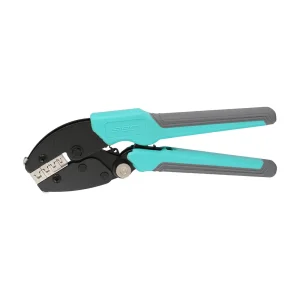
Contractors operating in Europe, Australia, and North America utilize our multi-profile pressing tools for PEX-AL-PEX, PE-RT, and copper press fittings. Jaws fit flush in restricted stud cavities, providing symmetrical 360-degree radial ring closure with minimal physical effort.
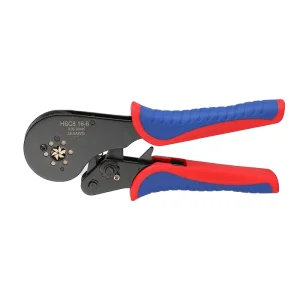
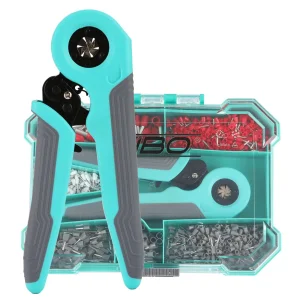
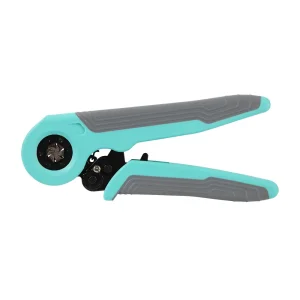
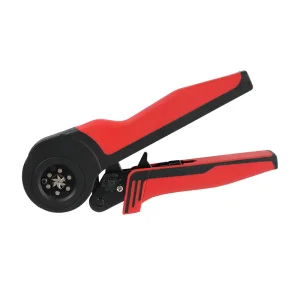
High-density PLC control panels depend on our miniature self-adjusting hexagonal ferrule crimpers (such as SO 10-6 and SO 16-6). They create compact, burr-free end sleeves that slide effortlessly into spring-cage terminal blocks with maximum contact surface area.
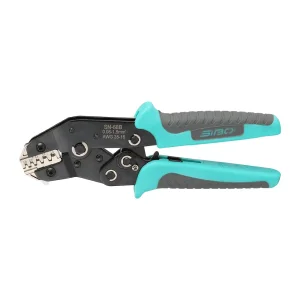
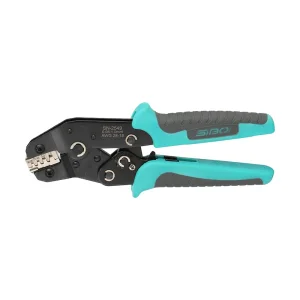
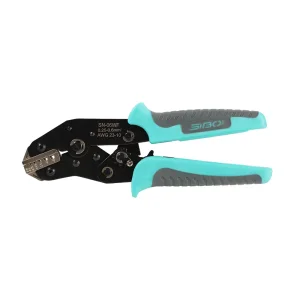
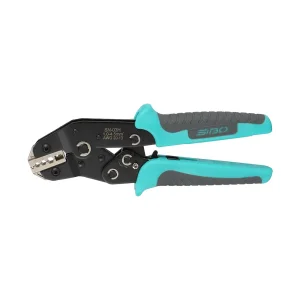
PV installers working in extreme ambient heat depend on our SN-2546B and SO-2546 Pro series for MC4 connector pins. High-precision ratchet calibration ensures micro-ohmic contact resistance, preventing arc flash hazards in 1500V DC utility strings.
Clear, highly detailed answers provided by our senior tool design engineers for commercial buyers, technical managers, and wholesale distributors.
While both tools utilize progressive lever advantage to induce plastic deformation, pipe crimpers (press tools) generate much higher compressive forces (typically 12kN to 32kN) distributed in a 360-degree radial ring across an outer metal sleeve (copper, stainless, or brass) over a semi-rigid plastic core (PEX or Multilayer). Wire terminal crimpers, by contrast, utilize specialized asymmetric cavities (such as B-crimp arches or indenters) to roll copper conductor strands into a consolidated gas-tight block without severing fine individual wire strands.
Our crimp dies are forged from premium Cr12MoV and 42CrMo alloy tool steel, followed by precision CNC roughing, computer-controlled vacuum heat treatment to HRC 58-62, and final slow-wire EDM finishing within ±0.005mm tolerances. This metallurgical integrity prevents structural jaw deflection, galling, and cavity wear even after tens of thousands of cycles under heavy mechanical loading.
Yes. As a direct source factory, over 40% of our production consists of OEM/ODM custom projects. Clients provide terminal samples, pipe sleeve CAD drawings, or fitting specifications. Our engineering team designs the die profile, simulates FEA stress distribution, and produces working prototype samples within 10 to 14 working days for dimensional and pull-force laboratory verification.
Self-adjusting hexagonal crimpers (such as the SO 16-6 series) employ six synchronized, stepped cam jaws that dynamically contract around the ferrule to match the precise conductor cross-section (from 0.08mm² up to 16mm²). This creates a completely symmetrical, round-like hexagonal profile with uniform 360-degree contact pressure, preventing conductor pinching and allowing effortless insertion into round DIN-rail cage clamps.
Every production batch undergoes five rigorous QC checks: 1) Spectrographic material alloy confirmation, 2) Rockwell hardness testing of jaws and pivot pins, 3) 100% full-cycle ratchet operation verification, 4) Calibrated pull-out tensile testing on digital test benches (up to 20kN), and 5) Optical cross-sectional micro-imaging to confirm uniform wall compaction without micro-cracking.
For standard catalog items with custom laser-etched branding and customized retail blister or box packaging, our standard MOQ is typically 500 to 1,000 units per model. Production lead time for standard wholesale reorders is 20 to 30 days. For completely custom-tooled new die profiles, initial pilot run samples are delivered within 15 days, followed by mass production in 35 days.
From European-style ferrule pliers to heavy-duty high-leverage ratchet cable cutters: Factory-direct solutions for electrical wholesalers and tool brands.
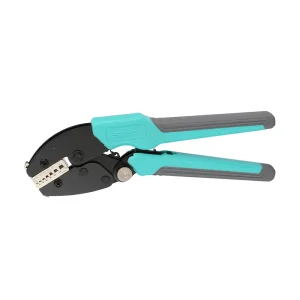
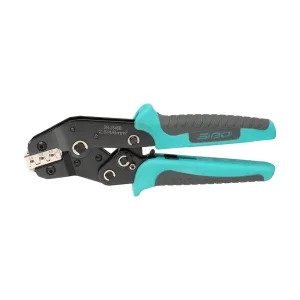
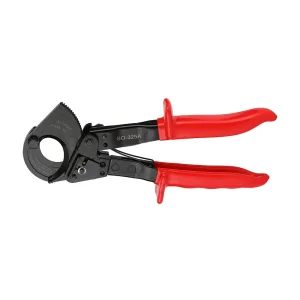
Request comprehensive product catalogs, CAD boundary models, custom die feasibility reviews, or private-label quotations directly from SIBO’s Yueqing engineering team. Fast turnaround within 24 business hours.
