Factory-direct industrial crimpers, calibration-certified ratchet mechanisms, and precision die units built in Yueqing, China for automated harness lines and critical field assemblies.
How the integration of end-of-arm tooling (EOAT), multi-axis articulating robotic arms, and closed-loop force sensing is redefining crimp structural integrity and connection reliability.
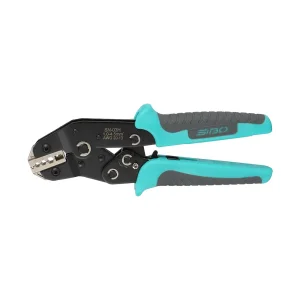
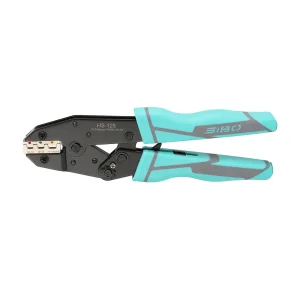
In modern industrial wire processing, wire crimping has graduated from an artisan-driven manual trade to an exacting electromechanical science governed by statistical process control (SPC). For decades, workshop hand tools such as the celebrated SN and SO series ratchet crimpers have provided the physical foundation for terminal compression. However, as electric vehicles (EVs), hyperscale solar farms, and aerospace avionics demand zero-defect yield rates (sub-ppm failure thresholds), global enterprises are shifting aggressively toward custom robotic crimper factories and turnkey automation services.
A robotic crimper acts as an intelligent end-effector mounted directly on 6-axis industrial robots or collaborative robots (cobots). Unlike a human technician whose grip force, approach angle, and cycle cadence naturally degrade over a shift, an automated robotic crimping station provides uniform radial and axial crimp trajectories with positional repeatability within ±0.01 mm. Furthermore, automated crimpers integrate dynamically with real-time Crimp Force Monitoring (CFM) systems, tracking the exact force-stroke signature curves across millisecond intervals to instantly detect missing strands, flash burrs, insulation slip, or asymmetrical ear folding.
Technical Insight: A high-capability robotic crimping process achieves a process capability index (Cpk) exceeding 1.67 across 100,000 continuous cycles, ensuring that critical parameters—including crimp height, compaction ratio (>85%), and tensile pull-out strength—adhere strictly to IPC/WHMA-A-620 Class 3 military and automotive criteria.
Custom robotics crimper factories must now bridge the metallurgical engineering of high-alloy tool steels with precision mechatronic interfaces. This entails manufacturing specialized quick-change die cassettes (QCC), pneumatic-electric hybrid intensification actuators, pneumatic scrap ejection chutes, and optical vision guidance cameras that confirm terminal orientation before the die closes. Sibo Tools has spearheaded this transition by combining over two decades of hand tool die-geometry mastery in Yueqing with precision-machined automation tooling, enabling Tier-1 harness builders to slash cycle times from 4.5 seconds down to under 1.1 seconds per crimp connection.
Micro-indent crimp profiles eliminate micro-voids between copper stranding, creating gas-tight cross-sections that resist corrosion, oxidation, and vibrational thermal degradation over decades.
Robotic end-effectors incorporate piezoelectric load cells that digitize compression curves at 10 kHz, automatically identifying flawed crimps and triggering ejector rejection mechanisms.
Tooling platforms feature sub-plate kinematic couplings that permit automated tool changers (ATC) on robots to swap terminal die sets in under 8 seconds without manual recalibration.
Enterprise procurement managers evaluating custom robotics crimper suppliers require uncompromising metallurgical longevity, certified tolerances, and seamless Industry 4.0 integration.
Mandatory for defense, medical, and aerospace harnesses. Dictates zero copper strand breakage, precise bellmouth clearances (0.1–0.5 mm), and uniform brush protrusion.
Strict retention force testing across wire diameters from 0.05 mm² (30 AWG) up to 240 mm², certifying the crimp barrel will break before terminal slippage occurs.
Automotive qualification specifying environmental thermal cycling (-40°C to +150°C), micro-ohm contact resistance stability, and cross-section micro-etching validation.
End-effector telemetry reporting cycle count, die displacement, temperature, and maintenance triggers directly to factory MES and SCADA systems.
| Tooling Series | Terminal Architecture | Wire Range Gauge | Crimp Geometry | Cycle Speed / Durability | Standard Compliance |
|---|---|---|---|---|---|
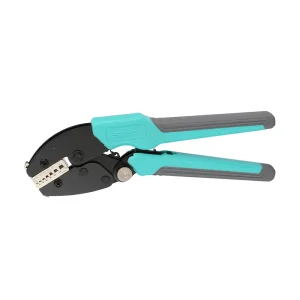
| SO-10WF Pro | Insulated / Twin End Ferrules | 0.25 – 10.0 mm² (24–8 AWG) | Trapezoidal Progressive | Manual Ratchet / 80k cycles | DIN 46228 Part 1 & 4 |
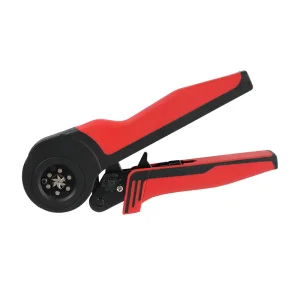
| SO 16-6 Hex | Precision Bootlace Ferrules | 0.08 – 16.0 mm² (28–5 AWG) | 6-Synchronous Hexagonal | Rotary Adaptive / 100k cycles | IEC 60947-1 / UL 486F |
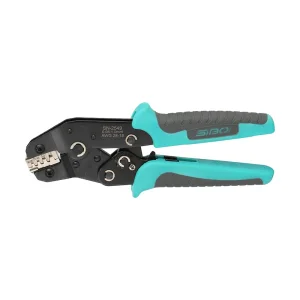
| SO-2546B Pro | MC4 Solar Photovoltaic Pins | 2.5 / 4.0 / 6.0 mm² (14–10 AWG) | Double-Indent B-Crimp | High Lever / 75k cycles | IEC 62852 / TÜV Rheinland |
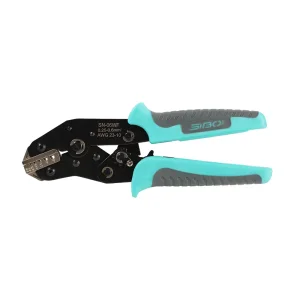
| SN-2549 Pro | Open-Barrel JST, Molex, Dupont | 0.08 – 1.0 mm² (28–18 AWG) | Precision Bellmouth B-Crimp | EDM Ground / 120k cycles | IPC/WHMA-A-620 Class 3 |
| SO-04B Pro | Non-Insulated Flag Terminals | 0.5 – 2.5 mm² (20–14 AWG) | 90-Degree Asymmetric Crimp | Full-Cycle / 85k cycles | SAE AS7928 / RoHS |
| Robotic EOAT-X | Closed & Open Barrel Terminals | 0.13 – 35.0 mm² (26–2 AWG) | Interchangeable CNC Die | 0.8s Cycle / 1.5M cycles | USCAR-21 / IATF 16949 |
From electric mobility busbars to hyperscale renewable microgrids, explore how specialized tooling solves demanding connection challenges.
Modern battery management systems (BMS) and high-voltage inverter links require shielded connector crimping without damaging internal dielectric braided layers. Sibo custom tooling guarantees low-contact-resistance crimping (<0.15 mΩ) on battery current rails, preventing thermal runaway and ensuring vibration resistance across extreme road endurance profiles.
Large-scale solar arrays operating at 1500V DC require flawless MC4 and multi-contact connector pin crimping using specialized ratchet tools such as the SO-2546B Pro. A poor crimp generates localized resistance, thermal degradation, and catastrophic arc-fault fires. Our hardened alloy dies ensure gas-tight outer sheath compressions that remain weather-resistant for over 30 years.
Internal dress packs on 6-axis industrial robots subject wiring harnesses to millions of torsional and flexural cycles. Standard crimps quickly suffer copper wire fatigue. By deploying mini European-style crimpers (SN-06WF, SN-03H) featuring radius-eased bellmouth cavities, mechanical stresses are distributed across the conductor, eliminating conductor fracture.
In-house manufacturing in Yueqing, Zhejiang Province, adheres to stringent metallurgical and quality engineering protocols to ensure long-term mechanical reliability.
The operational lifespan and dimensional repeatability of any crimping tool—whether an ultra-compact hand tool like the SN-06WF or a fully automated robotic crimping jaw—depend entirely on the quality of its metallurgy and thermal processing. Low-cost crimpers frequently fail because soft carbon steels deform under repeated mechanical stress, causing die expansion, uneven terminal ears, and under-crimping. At Yueqing Sibo Tools Manufacture Co., Ltd., we use premium-grade Cr12MoV, AISI D2, and 42CrMo cold-work alloy steels across our entire tool lineup.
Our production workflow incorporates multi-stage vacuum heat treatment paired with cryogenic tempering (-120°C). This process transforms retained austenite into tempered martensite, achieving a consistent surface hardness of 58 to 62 HRC while maintaining a resilient, shock-absorbing internal core. Die cavity profiles are then shaped using low-speed Wire Electrical Discharge Machining (WEDM) with mirror-finish surface grinding to ensure that cavity dimensions stay within an exceptional ±0.005 mm tolerance.
Every tool leaving our Yueqing factory undergoes strict calibration checks. Ratchet mechanisms are tested against calibrated dynamometers to verify that the release trigger engages precisely at the design-specified tonnage. When our global clients require private-label customization or dedicated robotic integration, our R&D engineering center provides rapid prototype die manufacturing within 72 hours, backed by optical cross-section metallographic inspection reports.
Fully compliant with EU RoHS and REACH environmental regulations. CE certified with full traceability documentation and factory-audited quality management adhering strictly to ISO 9001:2015.
We support global distributors across North America, Europe, Japan, and Korea with stable stock reserves, replacement jaw cassettes, and rapid air shipments to keep factory lines running.
Procurement teams communicate directly with experienced tooling engineers rather than passive middlemen, receiving terminal cross-sectional evaluations and die profile recommendations within 24 hours.
The wire termination landscape is advancing rapidly. Here is our strategic roadmap for integrating artificial intelligence, closed-loop telemetry, and dynamic mechatronics into industrial crimpers.
Integration of miniature coaxial laser micrometers directly inside robotic crimping jaws to perform non-contact, 360-degree crimp height and flash width measurements within 50 milliseconds post-crimp.
Edge-computing neural network modules embedded within the press controller that learn force-displacement curves in real time, automatically compensating for minor copper wire tensile variations.
Servo-electric intensification replacing conventional pneumatic cylinders, enabling dynamic micro-stroke adjustments down to 2-micron increments to maintain identical compaction across batch wire lots.
Advanced diamond-like nanocomposite (DLC) coatings paired with wireless wear-sensor matrixes that detect micro-pitting and surface wear, automatically alerting automated tool changing carousels.
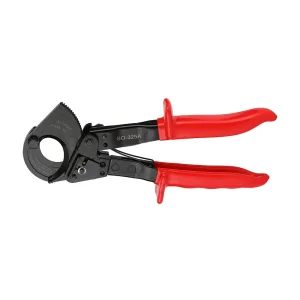
Explore our specialized closed-barrel crimpers, flag terminal systems, self-adaptive hex crimpers, and clean-cut cable shears manufactured for global OEMs and electrical contractors.
Clear, direct technical answers to the most common questions raised by harness system architects, quality directors, and global sourcing teams.
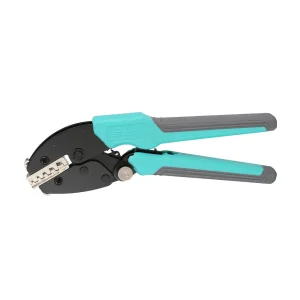
Manual ratchet crimpers rely on human mechanical input to advance through full-cycle ratchet steps. While our pro manual tools (e.g., SO-10WF Pro, SO-125) feature calibrated releases to ensure complete stroke closure, productivity is limited by operator fatigue. Robotic crimper end-effectors are actuated by pneumatic or servo-electric systems mounted to industrial robotic arms, delivering cycle times under 1 second, automated wire feeding, sub-micron positional repeatability, and live crimp force curve monitoring (CFM) connected to factory MES networks.
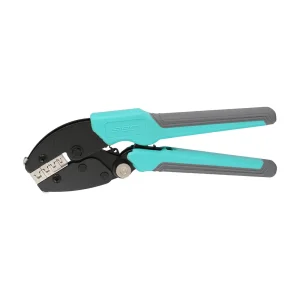
Gas-tight fusion requires compressing the copper wire strands within the terminal barrel until all internal air voids are eliminated, typically targeting an 80% to 90% compaction ratio without tearing the terminal material. Die cavities are machined with precise radii to roll open-barrel ears downward into the stranded core in a B-crimp or hexagonal format. This intense mechanical compression breaks the surface copper-oxide layer, facilitating micro-welding along contact faces and preventing gas infiltration, moisture intrusion, and galvanic corrosion.
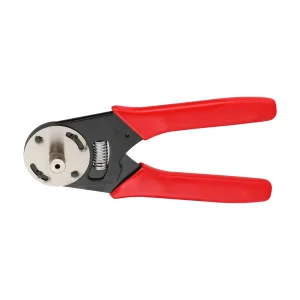
Closed-barrel solid contacts—such as Deutsch DT, DTM, and D-Sub series pins common in automotive and heavy-machinery harnesses—should not be crimped with conventional F-crimp or B-crimp tools. Instead, they require 4-indent or 8-indent radial crimping pliers, such as our Deutsch Closed Barrel DT series tool. These tools drive four opposing indenters inward simultaneously, ensuring symmetrical radial pressure without distorting the outer cylindrical barrel shell.
To produce custom tooling, clients provide the terminal manufacturer part number, terminal CAD drawings (.step/.dxf), bare conductor stranding specifications (strand count and AWG/mm²), and wire insulation diameter. Sibo Tools engineers run mechanical compaction simulations, machine test dies via precision Wire EDM within 72 hours, crimp sample harnesses, and supply cross-section micro-etching reports alongside destructive tensile pull-out test data.
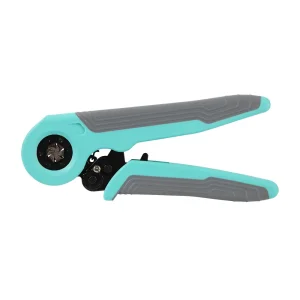
Traditional fixed-cavity ferrule crimpers require technicians to manually select matching die slots for each wire gauge. Self-adjusting models—such as the SO 10-6 and SO 16-6—employ a multi-jaw rotary linkage that automatically scales to the precise ferrule diameter inserted. The resulting uniform hexagonal cross-section fits smoothly into tight terminal block clamps, delivering 360-degree contact pressure and lowering contact resistance in electrical control cabinets.
For mission-critical automotive, aerospace, and medical harness manufacturing, Tier-1 buyers require a minimum process capability index (Cpk) of 1.33, with 1.67 or higher standard on high-voltage and safety-critical lines. Achieving this demands rigorous crimp height consistency within ±0.015 mm, steady conductor feeding, properly maintained die sets, and consistent metallurgical temper across terminal material batches.
