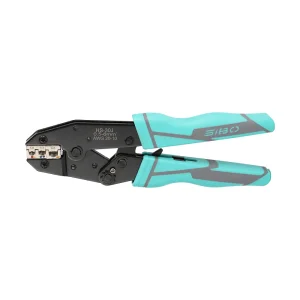
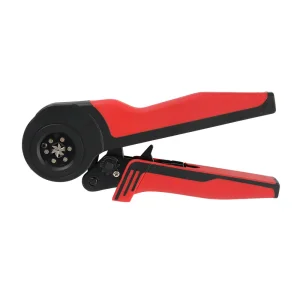
High-durability carbon steel frames, synchronized ratchet mechanisms, and precision EDM dies engineered for low contact resistance and zero strand fracture across diverse wire configurations.
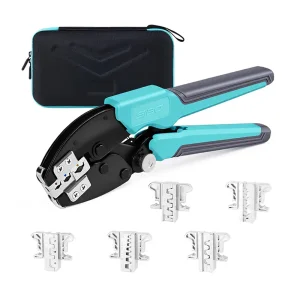
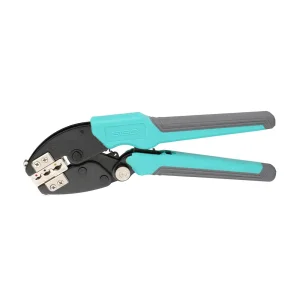
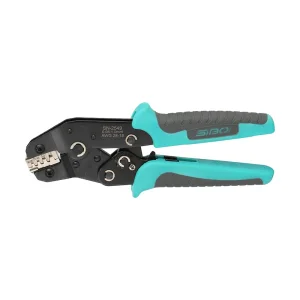
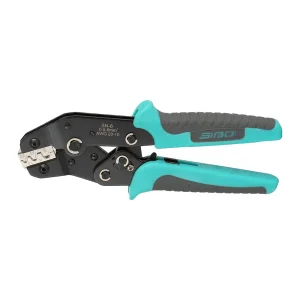
Modern electrical wiring assemblies demand crimping solutions that eliminate human error, guarantee repeatable pull-out force, and survive aggressive environmental cycling.
Global procurement teams across Tier-1 automotive and aerospace sectors now mandate full conformance to IPC/WHMA-A-620 Class 3 and IEC 60352-2 standards. Tool calibration logs, repeatable cycle counters, and serial tracking on interchangeable jaw profiles are baseline expectations.
With electric vehicle (EV) powertrains, photovoltaic inverters, and industrial robotics utilizing Class 5 and Class 6 fine-stranded conductors (DIN EN 60228), crimpers must control individual micro-strands from splaying during mechanical displacement.
Distributors and volume assemblers evaluate tool durability based on die wear cycles. SIBO's vacuum heat-treated AISI 4140 alloy steel and hardened tool steel dies deliver up to 50,000 failure-free crimp cycles without recalibration drift.
A reliable crimp is not merely a friction clamp—it is a solid-state cold weld that permanently forces copper strands into a monolithic polygon, eliminating oxygen ingress and micro-fretting corrosion.
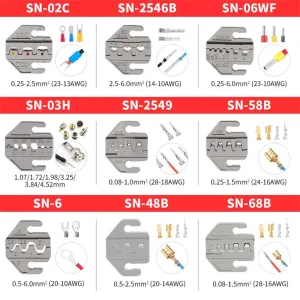
| Crimp Profile Type | Applicable Terminal Class | Strand Deformation Mechanics | Mechanical Retention Standard | Electrical Stability Criteria |
|---|---|---|---|---|
| B-Crimp (F-Crimp) | Open-Barrel Automotive & Signal Pins | Dual symmetric curling lobes compressing strands downward into core axis | USCAR-21 / SAE / ISO Pull test exceeds 180 N (AWG 16) | Millivolt drop <3.5 mV across crimp zone under thermal vibration |
| Hexagonal Compaction | End Sleeves, Ferrules, DIN 46228-4 | 6-sided isotropic pressure forming void-free polygonal matrix | DIN EN 60947-1 Prevents terminal clamp loosening | Eliminates individual strand hotspotting in switchgear contactors |
| Indent / W-Punch | Non-Insulated Heavy Ring & Spade Lugs | Deep central intrusion wedge displacing bulk copper laterally | UL 486A-B Pull-out values >450 N (8 AWG / 10mm²) | Gas-tight cross section verified via nitric acid etch inspection |
| Oval / Double-Crimp | Nylon / Vinyl Pre-Insulated Terminals | Simultaneous copper barrel swaging and strain-relief insulation clamp | MIL-DTL-22520G 100% containment of insulation sheath | Resistant to 1000 hrs salt spray per ASTM B117 testing |
Under-crimping leaves micro-voids between fine strands, initiating galvanic oxidation when exposed to moisture. Over-crimping thins the terminal wall and reduces cross-sectional copper area, causing mechanical embrittlement. SIBO crimper jaws are engineered with finite element analysis (FEA) to achieve exactly 15% to 20% total strand compression ratio.
In high-amperage commercial deployments, electrical joints must exhibit less than 0.5 milliohms interface resistance. By breaking the insulating copper oxide layer during high-pressure cold deformation, our crimpers create clean, inter-metallic contact zones that guarantee optimal thermal equilibrium under continuous 100% duty cycle.
In railway and heavy machinery, harmonic vibrations cause micro-displacement of cable strands inside terminal sleeves. SIBO's integrated insulation support dies crimp the PVC/silicone jacket with calibrated retention pressure, isolating mechanical shock from the conductive electrical termination zone.
From decentralized solar micro-grids to multi-axis robotics, manual and semi-automated wire crimping is entering a new paradigm of intelligent, sensor-monitored precision.
Application of Titanium Carbo-Nitride (TiCN) and DLC (Diamond-Like Carbon) coatings across critical jaw cavities, reducing galling wear by 320% when handling tinned and nickel-plated copper.
Intelligent tool holders equipped with passive NFC chips storing calibration dates, lifetime crimp counts, and approved terminal gauge pairings for digital ISO 9001 factory audits.
Development of piezoelectric strain gauge micro-sensors inside manual crimp arms, confirming that the operator achieved the specified peak tonnage curve before unlocking the ratchet.
Adoption of REACH and RoHS compliant handles utilizing non-toxic thermoplastic elastomers and bio-based polymers with zero plasticizer degradation under UV exposure.
From Yueqing's premier manufacturing base to distribution warehouses worldwide, SIBO supports complete private labeling, custom wire profile engineering, and localized certification.
Don't let non-standard terminal dimensions compromise your field assemblies. Our in-house engineering lab develops custom tool steels (SKD-11, D2, Cr12MoV) specifically profiled to your proprietary stamped or machined connector pins within 14 business days.
Build your brand equity with professional packaging, custom dual-color injected handle grips, high-contrast laser engraved metric/AWG graduation scales, and rugged heavy-duty Oxford tool bags customized for specialized contractor kits.
We provide full documentation required by international customs and corporate QA auditors, including RoHS 3 (EU 2015/863), REACH SVHC declarations, CE Machinery Directives, and raw material metallurgical test reports (MTR).
Critical considerations regarding stranded wire compression mechanics, die selection, pull testing, and industrial compliance standards.
Stranded copper conductors consist of numerous thin wires (ranging from 7 to over 100 strands depending on Class 2, Class 5, or Class 6 rating). Unlike a solid conductor that deforms uniformly, stranded wires tend to slip and shift during compression. A specialized stranded wire crimper features carefully calculated die geometry that applies progressive inward pressure, ensuring all peripheral and central strands are forced into each other without shearing the outer strands.
Using standard or flat-jaw pliers causes severe strand pinching, unequal current loading, hot spots, and eventual wire pull-out under mild mechanical vibration.
A gas-tight connection (tested according to DIN EN 60352-2 and IEC standards) occurs when the crimping force achieves solid-state plastic deformation, eliminating all air pockets between the copper strands and the connector sleeve. In this state, corrosive industrial gases (such as sulfur dioxide, hydrogen sulfide, or salt mist) cannot penetrate the core of the termination.
To verify this, laboratory cross-section micrographs are etched with acid; a genuine gas-tight joint displays a dense honeycomb polygon structure with zero interstitial gaps.
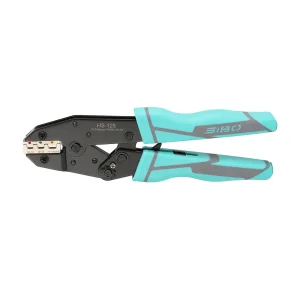
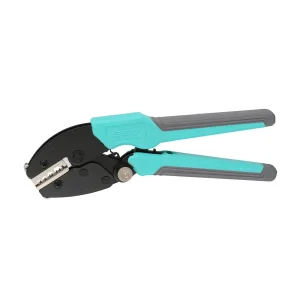
Operator fatigue is the primary cause of electrical terminal failure in manual manufacturing lines. SIBO's precision ratchet crimping tools incorporate an internal spring-loaded pawl mechanism that locks the handles once closed. The mechanism will not release until the tool handles are compressed completely to the mechanical stop position, guaranteeing that the exact pre-calibrated crimp height and compaction tonnage are applied every single time.
An emergency release lever is included to clear accidental foreign-body jams without damaging the tool frame or dies.
Under UL 486A-B and CSA C22.2 No. 65 standards, a crimped terminal must withstand a designated mechanical tensile load without conductor breakage or slipping from the barrel. For instance, AWG 18 wire requires a minimum retention of 89 N (20 lbf), AWG 14 requires 222 N (50 lbf), AWG 10 requires 356 N (80 lbf), and AWG 8 demands 400 N (90 lbf).
SIBO ratchet tools typically exceed these threshold values by 25% to 40% due to optimized die radii and friction-enhancing inner serrations.
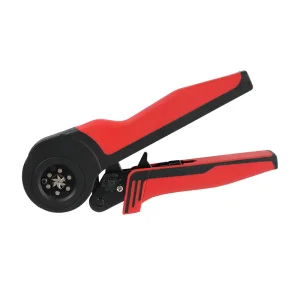
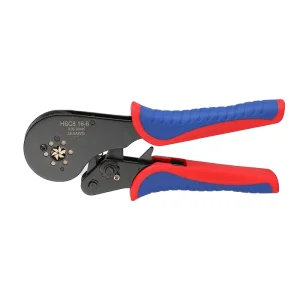
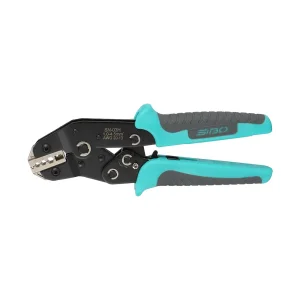
Fixed-cavity ratchet tools (like the SO-30J or SO-10 Pro) feature dedicated nested grooves for specific wire gauges (e.g., 0.5-1.0mm², 1.5-2.5mm², 4.0-6.0mm²), offering maximum compaction control for standardized repetitive high-volume work. Conversely, self-adjusting ferrule crimpers (such as the mini hexagonal 16-6 series) employ multi-jaw floating cams that automatically adapt to any wire diameter between 0.08 and 16 mm².
This self-adaptive mechanism speeds up control panel building by eliminating die switching when dealing with mixed terminal sizes in PLC terminal blocks.
Yes. As a direct source factory, we routinely develop custom magnetic-retention and quick-release jaw profiles. For photovoltaic installations, our SO-2546 series provides calibrated locator brackets and custom stepped dies for MC4, Amphenol H4, and TE SolarLok contacts, guaranteeing uniform contact resistance (<0.25 mΩ) to prevent PV string fires. We also engineer four-indent dies complying with MIL-DTL-22520 for aerospace circular connectors.
Explore high-leverage hexagonal self-adjusting ferrule crimpers, modular replacement jaw sets, and European-spec precision manual tools designed for industrial assembly plants.