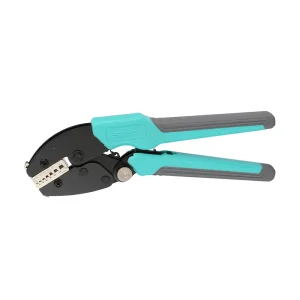
Engineered to eliminate crimp resistance variations and conform with strict IEC 60352-2 and UL 486A-B pull-out force criteria.
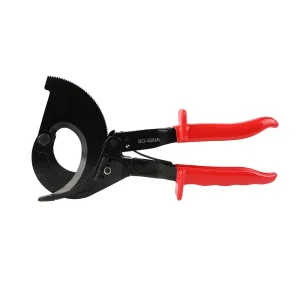
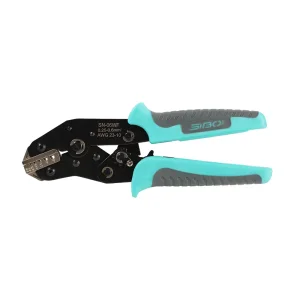
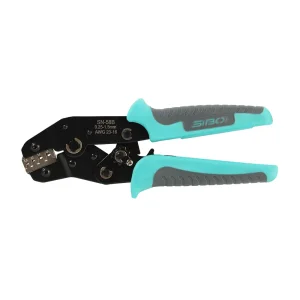
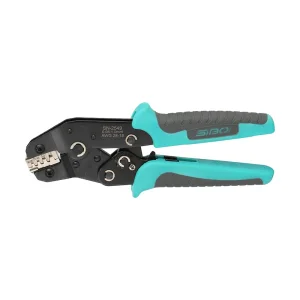
Analyzing macroeconomic shifts driving precision crimping demand across renewable infrastructure, commercial mobility, and smart grid automation.
Utility-scale photovoltaic installations operate under harsh environmental gradients. The proliferation of high-voltage DC combiner boxes demands MC4-compatible crimpers capable of producing near-zero milliohm electrical resistance to prevent thermal runaways and arc faults over 25-year operational lifespans.
Electrified mobility (BEVs and PHEVs) requires robust low-voltage control harness connections alongside high-voltage distribution lines. Tier-1 automotive harness makers enforce standardized B-crimp geometry on non-insulated open barrels to withstand multi-axis vibration profiles without wire detachment.
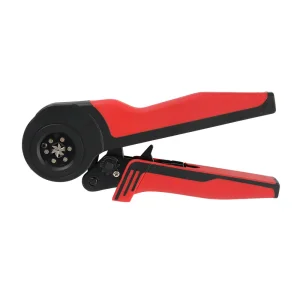
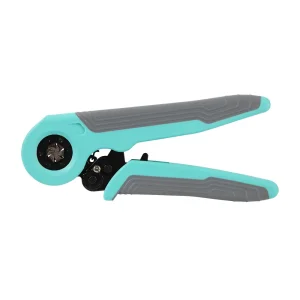
Compact DIN-rail cabinets demand self-adjusting ferrule tools that deliver uniform hexagonal or square crimp cross-sections. This uniform compression optimizes terminal block insertion density, enhances heat dissipation, and prevents multi-strand fraying under screw clamping mechanisms.
Technical Metric Benchmark: In accordance with DIN EN 60352-2 standards, gas-tight crimp connections must achieve cross-sectional compaction exceeding 85% of total metallic area to effectively arrest inter-strand electrolytic oxidation.
Why Tier-1 hardware brands source bulk crimping tools directly from China's primary electrical manufacturing center.
Yueqing houses an integrated ecosystem of metallurgy foundries, heat-treatment facilities, and wire-EDM die makers, cutting lead-times for customized tooling iterations to under 14 days.
Crimp jaws utilize premium tool steel (AISI 4140/AISI D2) formed via investment casting and CNC finishing, achieving dimensional tolerances within ±0.015mm for repeatable mechanical lock-in.
Full-cycle ratchet mechanisms undergo automated pre-shipment tension calibration, engineered to deliver a minimum service endurance of over 30,000 continuous compression cycles without jaw divergence.
Complete customized manufacturing encompassing dual-compound ergonomic handle molding (PP+TPR), custom laser batch serialization, packaging graphics, and dedicated die sets.
A reference architecture for procurement teams aligning terminal profiles with calibrated ratchet mechanisms.
| Series & Tool Class | Terminal Geometry | Applicable Cross Section | Deformation Topology | Key Standard Compliance |
|---|---|---|---|---|
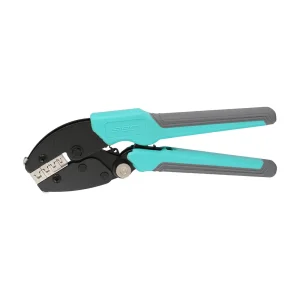
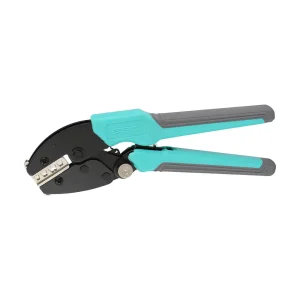
| SO-2546 Pro Series | Solar MC4 / Photovoltaic Pins | 2.5 / 4.0 / 6.0 mm² (AWG 14-10) | Curved double-roll B-crimp | IEC 62852 / UL 6703 |
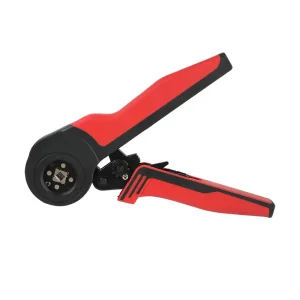
| SO-10-6 Self-Adjusting | Bootlace Ferrules (Insulated & Twin) | 0.08 - 10 mm² (AWG 28-8) | Centric Hexagonal Compression | DIN 46228 Part 1 & 4 |
| SO-30J / SO-125 Pro | Vinyl & Nylon Insulated Terminals | 0.5 - 6.0 mm² (AWG 20-10) | Oval & Double-Pressure indent | UL 486A-B / BS 4579 |
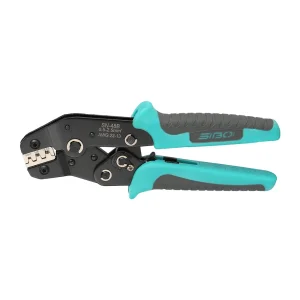
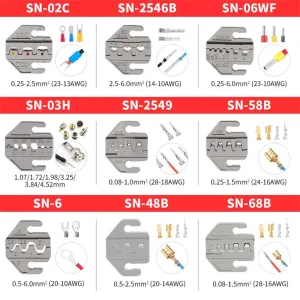
| SN-58B / SN-2549 | Open-Barrel Dupont, JST, Molex | 0.08 - 1.0 mm² (AWG 28-18) | Stepped micro-indentation | JASO D611 / IPC-A-620 |
| SO-10 Pro | Non-Insulated Heavy Ring/Spade Lugs | 1.5 - 10 mm² (AWG 16-8) | Deep mandril single-point indent | DIN 46234 / NF C 20-130 |
Continuous evolution from manual hand crimping to intelligent, cycle-audited field termination systems.
Modern electrical installation contracts involve thousands of daily terminations. Next-generation tools feature modified compound lever linkages, reducing handle actuation force by up to 35% without decreasing final jaw tonnage.
Contractors prefer consolidated kits over carrying several single-purpose tools. Our quick-change magnetic and slot-retained jaw systems (such as the 4mm SN series) enable swift die transitions across automotive, telecommunication, and standard electrical connections.
Global procurement teams prioritize factory direct suppliers capable of continuous batch verification, including micrographic cross-section cut testing, pull-out force graphing, and material spectral analysis.
Technical guidance covering factory capabilities, die selection, and compliance requirements.
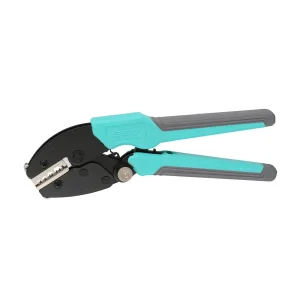
Ratchet crimping pliers utilize calibrated, fixed die geometries matching specific terminal gauges with a positive-locking cycle mechanism. Self-adjusting tools dynamically resize a multi-segment jaw array around the wire ferrule, eliminating manual die changes across mixed-gauge panel wiring.
Our tooling is designed to comply with DIN EN 60352-2 and UL 486A-B. Wire-EDM finished dies generate controlled deformation without shearing outer copper strands, consistently maintaining mechanical pull-out ratings above specified thresholds.
Standard OEM private branding (custom dual-color handle molding, pad-printed or laser-engraved logos, and custom packaging) generally starts at 500 to 1,000 units per model series. Stock factory finishes can be ordered at lower quantities.
Yes. Providing technical dimensional drawings or physical connector and wire samples allows our engineering team to model, wire-cut, and heat-treat custom die inserts, followed by cross-section micrograph verification.
Photovoltaic connections require double-roll B-crimp profiles matching standard MC4 pin dimensions (2.5/4/6 mm²). Calibrated ratchet tools ensure the contact barrel forms tightly around the wire core, preventing hotspots and maintaining water resistance.
Tool frames are stamped from cold-rolled alloy carbon steel and treated with black-oxide surface passivation or electrophoresis, providing balanced wear resistance, hardness, and corrosion protection for jobsite use.
Complete your supply chain requirements with batch-tested industrial tools manufactured in Yueqing, China.