
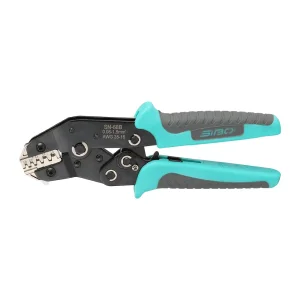
Engineered for low insertion effort, uniform geometric compaction, and cycle-calibrated release mechanisms matching global electrical engineering standards.
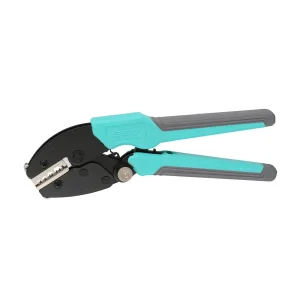
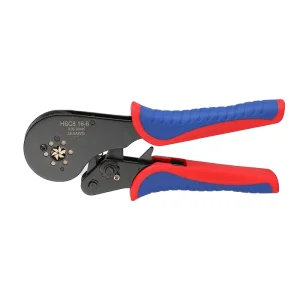
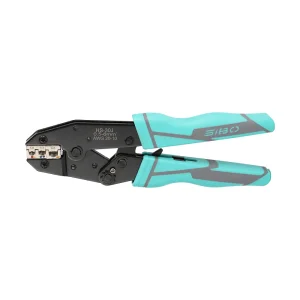
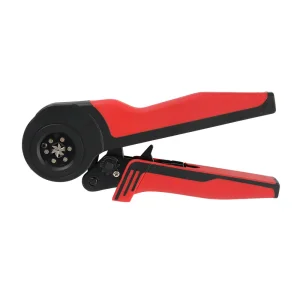
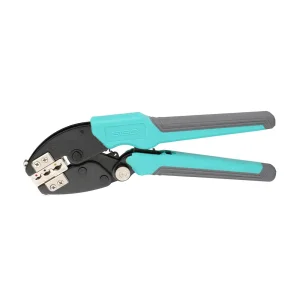
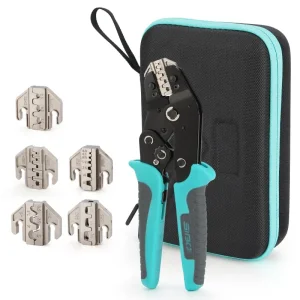
Transitioning from basic single-pivot plier physics to dual-stage mechanical linkage systems that safeguard electrical integrity across millions of industrial cycles.
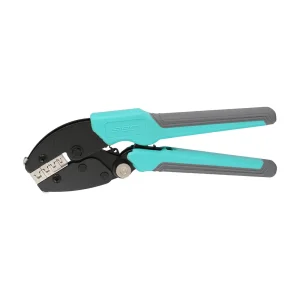
In contemporary industrial manufacturing, electrical harness fabrication, and field installations, the cold-pressure connection between copper conductors and electrical terminal lugs is an exact science. Traditional single-pivot crimping tools relied entirely on manual clamping pressure transmitted across a direct fulcrum. This design introduced catastrophic failure modes: inconsistent human gripping force resulted in under-crimping (causing elevated contact resistance, ohmic heating, and fire hazards) or over-crimping (inducing conductor shear, tensile fatigue, and early strand fracturing). In contrast, modern dual-action crimpers integrate a two-stage progressive compound leverage architecture paired with a non-slip, full-cycle ratchet brake mechanism.
Dual-action linkages convert a standard 200–300 N operator input force into a concentrated 12 kN to 18 kN crimping pressure at the jaw cavity. The initial action moves the jaw rapidly into position to grip the terminal barrel; the secondary mechanical shift delivers a massive force multiplier right at the point of terminal deformation.
Proper cold crimping demands plastic deformation beyond the elastic yield limit of both the terminal sheath and individual copper strands. Dual-action dies force copper strands to reshape into a void-free hexagonal or B-crimp cross-section, wiping surface oxides clean and establishing a gas-tight contact impervious to oxygen intrusion.
Equipped with micro-tooth ratchet mechanisms and emergency quick-release pawls, these tools guarantee that the jaws cannot spring open until the factory-calibrated bottom dead-center (BDC) stroke is attained. This completely eliminates manual error and operator fatigue from the quality assurance equation.
A comprehensive technical matrix bridging international regulatory benchmarks, metallurgical standards, and testing verification protocols.
When procurement managers and tooling directors from aerospace suppliers, solar EPCs, and automotive Tier-1 harness plants source dual-action crimping equipment, their criteria go far beyond initial purchase price. Critical procurement audits assess failure modes, total cost of ownership (TCO), die wear limits, and traceability standards.
| Evaluation Parameter | Commercial Grade Tool | Industrial High-Quality Dual-Action SIBO Standard | Testing & Compliance Protocol |
|---|---|---|---|
| Mechanical Linkage | Single pivot; direct leverage | Dual-stage synchronized toggle-linkage system | Kinematic mechanical advantage ratio > 1:35 |
| Tool Frame Material | Stamped Q235 low-carbon plate | Heat-treated 42CrMo / AISI 4140 structural alloy steel | Rockwell Hardness test HRC 44–48 |
| Jaw Die Composition | Cast zinc or basic powdered alloy | Precision-cast Cr12MoV vacuum heat-treated tool steel | HRC 58–62 surface durability threshold |
| Crimp Height Consistency | Varies ±0.15 mm under hand force | Controlled within ±0.03 mm across full cycle | Micrometer & digital cross-section micro-graphy |
| Electrical Contact Quality | Prone to micro-voids & oxidation | Complete gas-tight cold fusion compaction | IEC 60352-2 / UL 486A-B pull-out & mV drop tests |
| Calibration Integrity | None; fixed rivet architecture | Adjustable eccentric wheel pin with locking screw | In-service recalibration after every 5,000 operations |
Under international standards (such as DIN EN 60999-1 and UL 486C), the terminal-to-conductor bond must withstand rigorous mechanical separation forces. For example, a 6.0 mm² conductor must resist over 360 N of linear tensile stress without strand slippage. SIBO dual-action mechanisms routinely exceed standard pull-out ratings by 25–40%.
In high-amperage renewable energy lines and EV battery power rails, micro-resistance induces rapid thermal escalation. Our progressive dual-action dies eliminate intra-strand voids, delivering electrical conductivity virtually equivalent to a solid conductor and holding millivolt drop values well below the regulatory 3.2 mV threshold.
Repetitive Strain Injury (RSI) and carpal tunnel syndrome drive up operational costs and worker compensation claims in harness assembly lines. Dual-action designs cut peak hand grip force by 35%, while non-slip TPR dual-component handle geometries disperse palm contact pressure smoothly throughout the cycle.
How concentrated precision clusters, vertical manufacturing integration, and automated metallurgy enable rapid OEM delivery cycles and unmatched price-performance ratios.
Located in Yueqing, Zhejiang Province—the world-renowned capital of China’s electrical apparatus and low-voltage manufacturing industry—our facilities take full advantage of an ultra-specialized 50-kilometer industrial supply chain. From raw alloy steel procurement and specialized vacuum metallurgy to precision CNC wire EDM (Electrical Discharge Machining) and automated surface finishing, every critical process operates within an integrated manufacturing cluster.
Unlike trading assemblers who outsource crimping dies to disparate third-party job shops, SIBO designs, machines, hardens, and polishes all crimper dies in-house. Our high-precision slow-wire EDM ensures razor-sharp dimensional tolerance down to 5 microns (0.005 mm), ensuring true jaw mating without flash or uneven terminal distortion.
Global distributors can move from an engineer's 3D STEP terminal drawing to a functional, field-tested prototype tool in fewer than 15 business days. Our automated mold tooling centers and modular die frame blanks drastically compress development timelines, giving our brand partners a fast-mover market advantage.
Every single crimper batch faces non-destructive and destructive QA checks: torque-cycle fatigue runs on automated pneumatic testing rigs, optical projector inspection for cavity geometry verification, micro-section metallurgical crimp slicing, and salt spray anti-corrosion environmental tests exceeding 96 hours.
From desert photovoltaic arrays to complex aerospace avionics harnesses, our tools deliver consistent terminations across every operational environment.
Photovoltaic strings operate under extreme daily thermal swings from -30°C to +85°C. Imperfect open-barrel crimps cause severe arcing, which can ignite devastating rooftop and array fires. SIBO dual-action solar crimpers precisely form contacts on 2.5 mm², 4.0 mm², and 6.0 mm² PV cross-sections, guaranteeing zero contact resistance drift over a 25-year operational lifecycle.
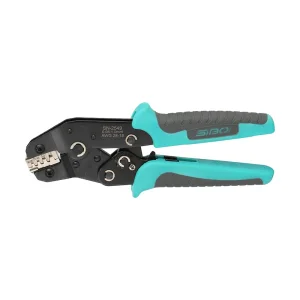
EV vibration profiles stress every single harness splice and connector. Our specialized SN series tools crimp micro-terminals and non-insulated flag connectors with a balanced B-type roll crimp. This design creates smooth conductor entry transitions that eliminate stress raisers and shield connections against fatigue fractures under constant harmonic road vibration.
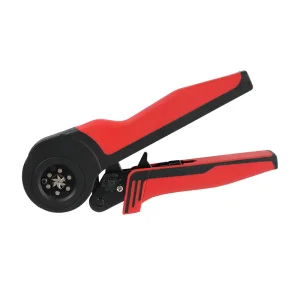
Modern automated switchboards require thousands of high-density wire-end ferrule terminations. SIBO’s self-adjusting hexagonal and square ferrule crimpers (such as the SO 16-6 series) automatically adapt across 0.08 mm² to 16 mm² wires. The resulting geometric hexagonal profile slides easily into spring-cage or screw clamps without catching on stray fine-wire filaments.
High salt spray and ambient moisture can quickly degrade standard industrial tools. SIBO crimper jaws and bodies receive a proprietary electroless nickel-phosphorus treatment and black oxide immersion. This creates an impenetrable protective barrier against corrosive atmospheres in maritime bridge wiring and offshore wind nacelles.
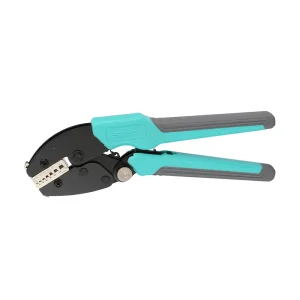
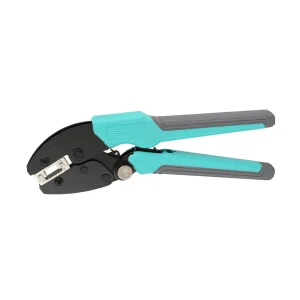
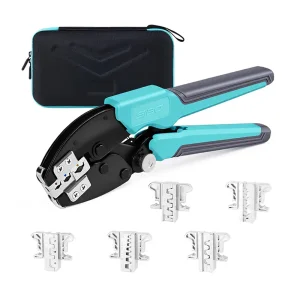
Versatile quick-change systems, specialized flag terminal dies, and adjustable pressure configurations engineered for direct global procurement.
In-depth engineering answers covering tool kinematics, die tolerances, OEM private labeling, and global compliance testing.
Standard ratchet tools use a single pivot pin where mechanical leverage drops off significantly as the handles close. In contrast, dual-action crimpers incorporate an intermediate toggle-link mechanism. This arrangement produces two distinct mechanical velocity ratios: a rapid closing phase to secure the connector, followed by an exponential surge in mechanical advantage (exceeding 1:35) right at bottom dead center, cleanly delivering the massive force needed for cold gas-tight deformation without straining the operator.
Our crimper dies are cut using high-precision wire electrical discharge machining (EDM) in controlled-temperature workshops, maintaining tolerances within ±0.005 mm. Before leaving the cell, all dies are measured on automated 3D optical coordinate systems (CMM) to verify profile geometry, depth, and curvature radius against engineering CAD models, ensuring dependable consistency across thousands of tools.
Yes. As a direct manufacturer, custom die engineering is one of our primary strengths. By providing terminal samples, conductor cross-sections, and technical drawings, our Yueqing R&D engineering team can model the die profile, simulate material deformation under compression, and ship custom hardened tool prototypes within 10 to 15 business days.
We provide comprehensive white-label solutions, including dual-color TPR handle molding matched to your specific brand pantone, laser-etched logo identification, custom dial-wheel calibration markings, branded blow-mold cases, ballistic Oxford fabric tool pouches, and retail packaging compliant with European and North American retail distribution standards.
All SIBO professional dual-action crimpers feature an eccentric adjustment wheel secured with an Allen or Torx locking screw. As the mechanical linkage faces normal operational wear after 5,000–10,000 crimp cycles, technicians simply loosen the set pin and rotate the eccentric gear counterclockwise by one notch to re-establish nominal bottom dead center compression height.
Our tools meet all relevant international performance standards, including IEC 60352-2 (solderless crimped connections), UL 486A-486B (wire connectors), and DIN 46228 parts 1–4 (wire ferrules). On request, we provide tensile pull-test verification reports, metallurgical cross-section micrographs, and raw material certificates with every commercial shipment.
Eliminate intermediary markups, shorten product development lead times, and deliver certified, heavy-duty crimping tools engineered precisely to your market's technical demands.