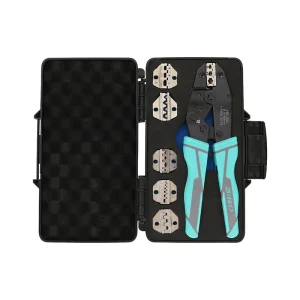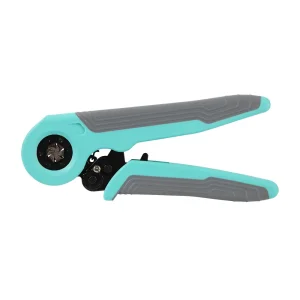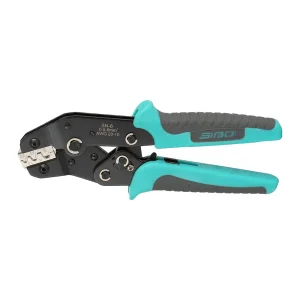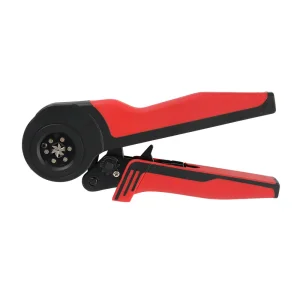
Self-Adjustable · Ferrules
Factory-calibrated ratchet mechanics, self-adjusting quadrangular/hexagonal crimp profiles, and multi-cavity hardened dies designed for repeatable mechanical and electrical integrity.
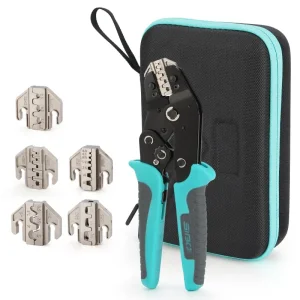
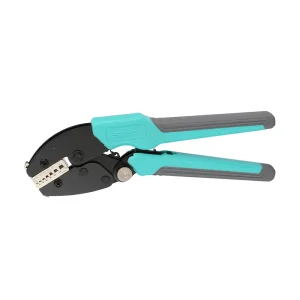
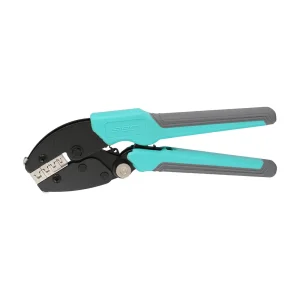
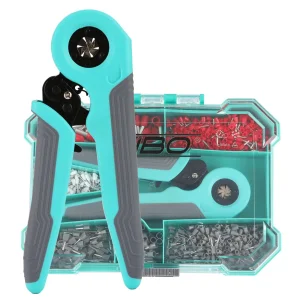
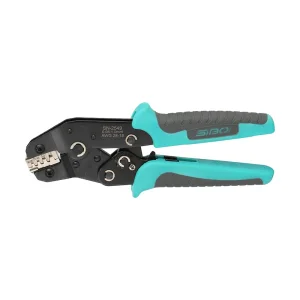
Understanding cold-weld molecular fusion, mechanical stress vectors, and compliance standards governing mission-critical wire-to-pin terminations.
In modern electrical engineering, the humble pin crimper represents a foundational nexus between electrical reliability and mechanical tensile endurance. Far beyond a simple pinching mechanism, an industrial-grade pin crimping tool executes a highly choreographed metallurgical displacement. When stranded conductor copper wires are compressed into a stamped-and-formed or solid-machined pin terminal barrel, the compression must eliminate air pockets, break microscopic copper oxide layers, and induce plastic deformation without over-thinning terminal walls or severing micro-strands.
A compliant crimp creates an airtight, gas-tight joint wherein the contact resistance remains negligible over decades of thermal cycling and mechanical vibration. Poor-quality tools with sub-optimal lever mechanics or loose pivot tolerances introduce irregular radial stress. Under-crimping leaves micro-voids vulnerable to oxidation and corrosive ingress, sparking localized heating and catastrophic thermal runaway. Conversely, over-crimping creates work-hardened, embrittled conductors that fracture under cyclic mechanical fatigue.
Under controlled compression, wire filaments undergo geometric transformation into a solid polygon mosaic, expelling oxygen and preventing ionic oxidation over extended operational lifespans.
Internal mechanical release cams guarantee the tool cannot be opened prematurely until the crimp jaw closes to the calibrated terminal closure height, neutralizing manual operator fatigue.
Formed via vacuum heat-treated AISI 4140 chrome-molybdenum or S2 tool steel, precision EDM wire-cut cavities resist wear from nickel, tin, or gold-plated phosphor bronze terminal pins.
How electrification, decentralized solar energy, automotive smart cabins, and industrial edge computing reshape B2B procurement requirements.
Automotive harnesses now incorporate hundreds of multi-pin miniaturized headers for ADAS, LiDAR, and battery management nodes (BMS), driving urgent demand for ultra-compact 0.05–0.5 mm² pin crimpers.
High-voltage 1500V DC utility installations necessitate specialized ratchet tools configured for MC4 and solid-machined pins, preventing arcing and costly localized thermal degradation.
Control cabinet assemblers demand four-indent and hex-profile ferrule tools to land ultra-fine copper strands securely into spring-clamp terminal blocks without splaying loose wire filaments.
Global tool distributors require white-label manufacturing featuring custom dual-color TPR handle moldings, laser serialization, customized jaw dies, and customized field packaging solutions.
How localized electrical clusters, multi-axis robotic machining, and comprehensive in-house quality assurance establish a global benchmark for pin crimper production.
Located in Yueqing, Zhejiang—the epicentre of China's electrical apparatus manufacturing—our facility operates inside an end-to-end supply radius. Within 15 kilometers, we source certified carbon steel rod, specialized elastomer molds, vacuum thermal processing, and eco-friendly electroplating. This proximity eliminates maritime logistical delays and shortens prototype-to-production lead times from months to under two weeks.
This dense industrial matrix enables high-mix low-volume (HMLV) responsiveness without sacrificing unit economies of scale. Global clients benefit from immediate tool modifications, rapid die re-profiling, and seamless ramp-up for urgent containerized export dispatches.
Our workshop integrates automated high-precision EDM wire-cutting stations alongside multi-station stamping presses. Every crimp die profile is digitally programmed to maintain tolerances within ±0.01 mm, ensuring that identical die geometries are mirrored across tens of thousands of production units.
Subsequent controlled-atmosphere vacuum quenching and tempering cycles stabilize metallurgical microstructures, preventing handle flexing or premature jaw erosion. Every tool batch undergoes automated torque testing, cycle endurance trials, and optical comparator inspections prior to assembly.
Compare terminal barrel geometries, operational requirements, recommended SIBO series, and mechanical pull-force verification standards.
| Terminal & Contact Type | Primary Industrial Sector | Recommended SIBO Model | Crimp Profile | Tensile & Electrical Standard |
|---|---|---|---|---|
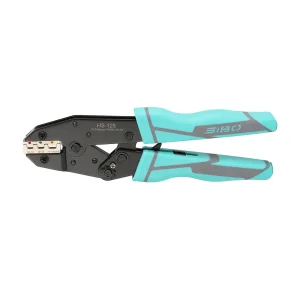
| Pre-Insulated Ring / Spade / Pin | Switchgear, Building Wiring, Control Panels | SO-30J Pro / SO-125 Pro | Color-Coded Oval Crimp | UL 486A-B / DIN 46245 |
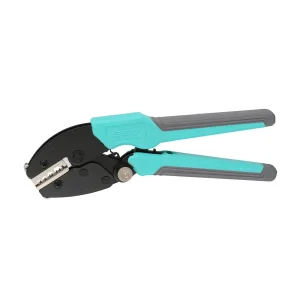
| Wire-End Ferrules (Bootlace) | Industrial Automation, PLC Wiring, VFDs | SO 16-6 / SO-10WF Pro / SO 10-6 | Self-Adjusting Hex / Square | DIN 46228 Part 1-4 |
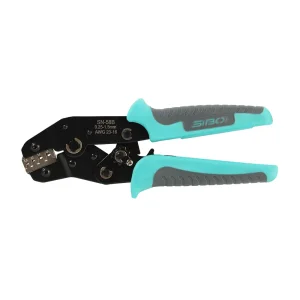
| Open Barrel / Stamped Pins | Automotive Harness, White Goods, Sensors | SO-04BPro / SN-2549 / SN-58B | B-Crimp (F-Crimp) Double Fold | SAE / USCAR-21 |
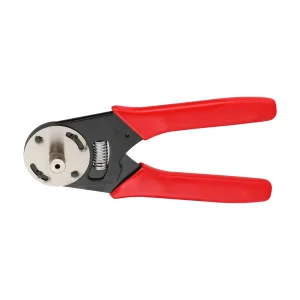
| Solid Turned Barrel (D-Sub / DT) | Commercial Avionics, Heavy Machinery, MIL-Spec | Deutsch Closed Barrel (20-16 AWG) | 4-Indent 8-Impression Radial | MIL-DTL-22520 |
| Photovoltaic Solar Contacts | Solar Utility Arrays, Rooftop PV Inverters | SO-2546B Pro / SO-2546C Pro | Direct Fit 2.5 / 4 / 6 mm² Die | IEC 62852 Standard |
| Non-Insulated Lugs & Flag Terminals | HVAC Compressors, Motor Starters, Battery Leads | SO-04B Pro / SO-10 Pro / SN-6 | Indent Punch & Flag Angle Nest | IEC 60352-2 / UL 310 |
How each batch of pin crimpers is verified for geometric fidelity, ratchet release reliability, and cold-weld tensile integrity.
Random samples from every production run are crimped onto standardized stranded conductors and subjected to axial tension on an automated digital pull-force dynamometer.
Sample crimped pins are sliced transversely, mounted in resin, polished to optical clarity, and inspected under high-power digital microscopes.
Pneumatic test rigs cycle crimper mechanisms through 30,000 to 50,000 full-compression strokes under load to verify pivot pin tolerances and ratchet spring fatigue.
Detailed technical and commercial answers directly from our factory engineering team to assist distributor evaluation and OEM procurement.
Self-adjusting crimpers (such as our SO 16-6 and SO 10-6 series) employ a dynamic four- or six-synchronous cam jaw mechanism. As you compress the handles, the jaw automatically adapts its aperture to match whatever wire ferrule cross-section is inserted (from AWG 28 up to AWG 5). Fixed-cavity ratchet tools (like the SO-10WF Pro) feature specific, discrete cutouts tailored to predetermined conductor sizes. Fixed tools provide extreme dimensional precision for standardized repetitive manufacturing lines, whereas self-adjusting tools offer maximum field speed for maintenance contractors working across varied gauge cross-sections.
Crimp height (CH) is the primary non-destructive measure of crimp quality. It is determined by contact manufacturer specifications, wire conductor area, and barrel material thickness. Using a blade micrometer, measurement is taken across the midpoint of the conductor crimp section. Proper crimp height must yield a compaction ratio between 15% and 20% copper reduction, ensuring adequate pull-out retention without cracking the barrel fold. Our dies feature laser-etched cavity sizes and bellmouth reliefs to maintain these tolerances across every crimp.
Yes. Yueqing Sibo Tools provides end-to-end ODM engineering for custom terminals. Clients provide CAD drawings (.step/.dwg) or physical contact pin samples alongside conductor specifications. Our R&D department calculates the neutral bending line, models the die clearance, and machines prototype tooling via wire EDM in 7 to 10 working days. Following destructive pull testing and optical micrograph validation, hardened production die sets are ready for serial assembly.
We support comprehensive white-labeling programs for regional and multinational tool brands. Customization parameters include dual-color ergonomic handle grips matched to your corporate Pantone codes, permanent high-resolution fiber laser engraving of brand logos and part numbers, custom molded carrying cases, blister packaging, and full-color Oxford tool kit pouches. We also accommodate custom barcoding, serial batching, and bilingual user manuals.
The bellmouth flare is a slight chamfered expansion formed at the front and rear edges of the terminal crimp barrel during compression. Without a rear bellmouth, the sharp metallic edge of the compressed barrel cuts into the outer conductor strands under vibration, acting as a stress riser that leads to premature wire snapping. Our wire-EDM crimp dies are machined with calculated transitional lead-in radiuses to automatically form the correct bellmouth dimension specified by automotive USCAR-21 and IEC guidelines.
Standard models in stock ship within 5 to 7 business days. OEM custom production runs generally require 20 to 30 days depending on custom packaging and die customization complexity. Minimum Order Quantities (MOQs) start at 200–500 units for customized brand markings, while off-the-shelf standard tools can be ordered in lower trial quantities. We stand behind our tools with an unconditional 12-month mechanical warranty covering manufacturing defects, ratchet spring assemblies, and jaw metallurgical soundness.
Engineered for micro-pitch electronic pins, solid closed-barrel aerospace terminals, multi-jaw combination field kits, and heavy-duty pre-insulated lines.