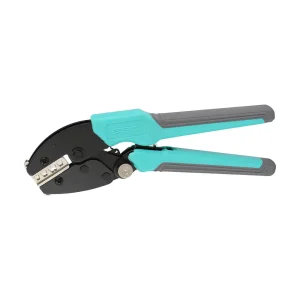
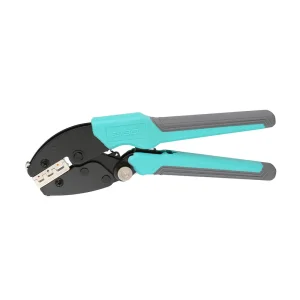
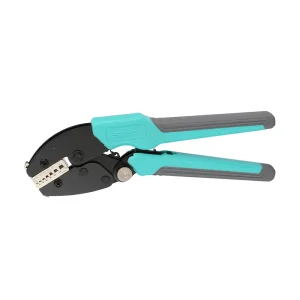
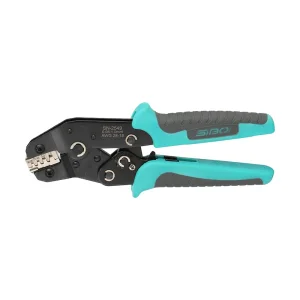
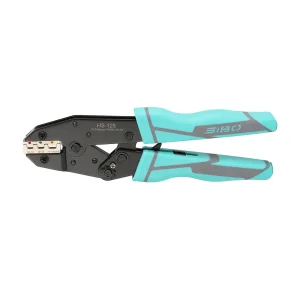
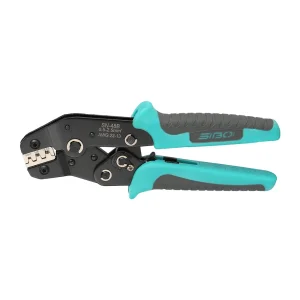
Industrial crimping tools featuring calibrated ratchet release mechanisms, EDM wire-cut dies, and ergonomic leverage profiles for electrical contractors and automated wire harness assemblers.
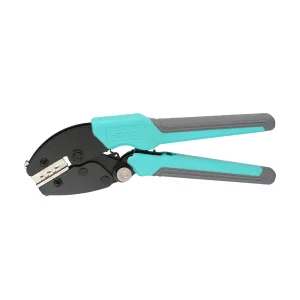
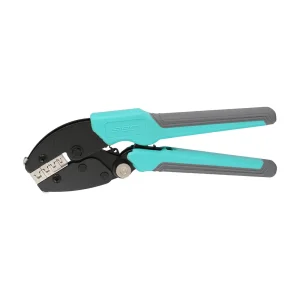
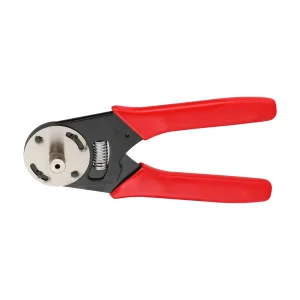
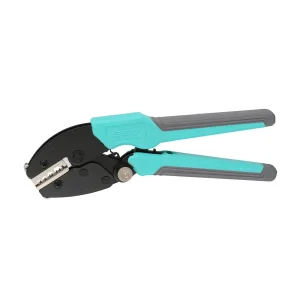
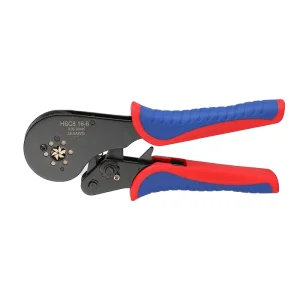
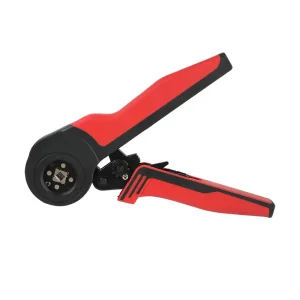
Achieving true hermetic seal integrity requires understanding the plastic deformation kinetics of copper, conductor strand compaction thresholds, and the avoidance of terminal stress relaxation.
Under controlled die stroke compression, individual copper strands break through their native surface oxide films. High compressive force forces the strands into intimate atomic proximity, creating a cold-weld boundary that eliminates micro-voids and blocks oxidizing atmospheric intrusion.
Proper crimp geometry targets an optimum compaction ratio of 80% to 85%. Ratios above 90% risk excessive strand nicking and notch fatigue, while ratios below 75% lead to galvanic ingress and thermal rise failures under continuous load.
The connector pin terminal sleeve (typically CDA 260 Brass, Phosphor Bronze, or Annealed ETP Copper) and the stranded cable core exhibit disparate modulus of elasticity and elastic recovery factors. When tool jaws unclamp, the terminal wall naturally tends to expand.
Precision pin crimper dies compensate for spring-back through mathematically calculated over-compression relief channels. This maintains high residual contact force over decades of thermal cycling (-40°C to +125°C), preventing micro-arcing and contact resistance creep.
A mechanically robust crimp joint must exceed standardized destructive mechanical separation limits before strand slippage occurs. SIBO crimper jaws deliver mechanical interlock profiles that transfer tensile loads uniformly across the conductor cross-section.
By enforcing accurate crimp height (CH) tolerances of ±0.03 mm, our tools guarantee pull-out retention forces that exceed UL 486A-B and DIN 46228-4 standards by an average of 18% to 25% across test batches.
| Wire Size (AWG / mm²) | Terminal Architecture | Standard Pull-Off Req. (N) | SIBO Achieved Value (N) | Compaction Ratio | Contact Resistance (mΩ) | Compliance Status |
|---|---|---|---|---|---|---|
| 20 AWG (0.5 mm²) | Solid Turned Pin (Deutsch DT) | ≥ 70 N | 94.5 N ± 3.2 | 82.4% | 0.28 mΩ | UL 486A PASS |
| 16 AWG (1.5 mm²) | Wire-End Pin Ferrule | ≥ 100 N | 142.0 N ± 4.8 | 83.8% | 0.19 mΩ | DIN 46228 PASS |
| 12 AWG (4.0 mm²) | Solar PV Contact (MC4 SO-2546) | ≥ 310 N | 425.8 N ± 8.1 | 84.6% | 0.08 mΩ | IEC 62852 PASS |
| 10 AWG (6.0 mm²) | Non-Insulated Open Barrel B-Crimp | ≥ 360 N | 490.2 N ± 9.4 | 85.1% | 0.06 mΩ | SAE AS7928 PASS |
Located in China's low-voltage electrical capital, Yueqing Sibo Tools leverages unmatched industrial clustering, vertically integrated tooling, and intelligent quality gates to achieve maximum supply chain resilience.
Yueqing houses over 60% of China’s electrical connector and switchgear output. Being embedded in this dense geographic ecosystem grants our factory instantaneous access to certified metallurgical stock (40Cr forged carbon steel, brass alloy, specialty polyamides) within a 15-kilometer radius.
This localized supply chain compresses prototype iterations from months to days, allowing rapid prototyping of bespoke terminal profiles and swift mold fabrication without offshore freight delays.
Unlike trading entities or assembly shops that outsource core tooling, SIBO conducts 100% of die engineering, multi-axis CNC blanking, slow-feeding Wire EDM cutting, and computer-controlled vacuum heat treating internally.
Dies are ground from premium Cr12MoV cold-work tool steel, achieving deep, uniform hardness without core brittleness. Post-machining optical comparators inspect every die contour against 3D CAD master envelopes before handle pairing.
Every batch of steel undergoes optical spectrometry to verify carbon, chromium, and molybdenum alloy percentages prior to stamping. Serialized ratchet sub-assemblies undergo digital torque curve calibration to ensure release detents activate precisely when full crimp closure occurs.
Pre-shipment batch validation executes destructive pull-off tests, optical cross-section micrography, and salt-spray corrosion chamber exposure (72 hours per ASTM B117), securing international tool distributors from warranty liabilities.
Chemical verification of 40Cr steel plates and high-grade die alloys.
Sub-micron wire electrical discharge machining of terminal die nests.
Multi-stage computer-controlled heat treatment to HRC 58-62.
Micro-adjusting eccentric wheel for exact pressure release points.
Mechanical pull-out and dimensional tolerance check prior to packaging.
How SIBO pin terminal crimping tools eliminate downtime, resist extreme vibrations, and uphold system safety across mission-critical global infrastructures.
Equipped with our SO-2546B Pro and SO-2546C Pro ratchet crimpers, utility-scale photovoltaic installers eliminate high-resistance string joints in MC4 solar connector pins on 2.5 mm², 4.0 mm², and 6.0 mm² cables. Gas-tight compression resists extreme outdoor UV degradation, thermal shock (-40°C to +90°C), and prevents destructive PV string fire risks.
Modern automotive sensor nodes, battery management units (BMS), and Deutsch DT connector blocks require closed-barrel pin termination that withstands continuous ISO 16750-3 road vibrations. Our four-indent / eight-indent custom tools deliver 360-degree radial pin clamping, preserving contact continuity without pinching fine-strand EV copper cables.
Panel builders handling dense PLC terminal strips rely on our HSC8 16-6 hexagonal and SO 16-4 self-adjusting ferrule crimpers. Hexagonal profiles ensure 100% round-envelope insertion into cage-clamp terminals (IEC 60947-7-1), preventing stray strand shorts, minimizing panel footprint, and accelerating assembly throughput by up to 35%.
Avionics instrumentation, radar communication cabinets, and cellular base stations demand micro-millivolt drop stability across D-Sub miniature pins. SIBO open-barrel SN-2549 and SN-48B tools execute precision dual B-crimps—simultaneously cold-welding the conductor core while gently folding stress-relief tabs over outer cable insulation jackets.
How corporate procurement heads balance unit tooling cost against field failure liabilities, operator ergonomic fatigue, and OEM private-label brand equity.
Procuring cheap non-ratcheted or low-carbon stamped crimping tools creates hidden capital liabilities. A single under-crimped connection in an industrial panel can result in tens of thousands of dollars in emergency service calls, factory line stoppages, or electrical fire damage.
SIBO’s hardened, calibrated ratchet mechanism ensures full cycle completion—preventing tool release until proper compaction pressure is reached. This drops installation error rates to virtually zero, protecting corporate brand reputation.
Manual harness technicians perform thousands of crimping operations each working shift. Sub-standard tools require over 30 kg of grip pressure, leading to hand fatigue, musculoskeletal disorders (MSDs), and an afternoon drop-off in terminal crimp consistency.
Our tools incorporate progressive compound toggle levers and dual-durometer TPR soft grips. The optimized mechanical advantage cuts required squeeze effort by up to 40%, keeping assembly operators efficient, energized, and accurate from start to finish.
For international tool distributors, retail hardware chains, and catalog wholesalers, SIBO offers turn-key OEM personalization. We support laser engraved logo branding, custom corporate color matching for handle grips, retail blister packaging, and dedicated Oxford bag multi-tool combo kits.
Our Yueqing engineering department co-develops bespoke crimping jaws matched specifically to newly patented customer connector terminals, delivering full technical files and sample runs with fast turnaround.
How SIBO bridges direct China factory manufacturing power with localized European, North American, and Asian distributor compliance and warranty demands.
Every tool model is engineered to satisfy RoHS 2011/65/EU and REACH (EC 1907/2006) chemical environmental directives. Our electrical terminal joints routinely achieve UL 486A-B, IEC 60352-2, and DIN 46228 accreditation during downstream customer device listings.
To insulate overseas supply chains from global maritime shipping disruptions, SIBO manages dedicated safety stock programs for key recurring OEM distributors. Mixed SKU container consolidation and sea-air split shipments ensure zero stock-outs.
We supply serialized spare die sets, ratchet gear repair springs, and calibration eccentric pins directly to distributor regional service depots. Comprehensive video servicing manuals and engineering call support empower fast localized repairs.
SIBO regularly hosts on-site or digital live-stream factory audits for international procurement officers. We maintain complete traceability binders covering steel supplier heat treat certificates, calibration logs, and machine maintenance records.
From smart sensor-integrated hand tools to ultra-miniaturized wire gauge dies, discover our ongoing research into next-generation electrical joint reliability.
Our advanced R&D team is developing strain-gauge embedded ratchet levers equipped with micro Bluetooth modules. By sampling the dynamic force-displacement curve during tool closure, the tool automatically validates whether the correct terminal-to-wire combination was inserted.
Real-time green/red LED cues notify the operator of pass/fail results, and batch data logs automatically synchronize with factory MES software for 100% digital trace compliance in automotive assembly plants.
As medical robotics, industrial cobots, and drone flight controllers compact their electronic payloads, wire harnesses are migrating from 24 AWG down to micro 32 AWG (0.03 mm²) pin geometries.
SIBO is investing in nanoscale Swiss-precision EDM wire systems and tungsten-carbide die inserts to prevent pin wall collapse, burring, or strand severance in high-density 1.0mm-pitch connector housings.
In line with global ESG sustainability imperatives, SIBO is transitioning handle mouldings toward bio-based post-consumer recycled thermoplastic elastomers (TPE), eliminating harmful plasticizers without compromising chemical resistance or oil grip.
Tool frames are optimized via finite-element analysis (FEA) to reduce structural steel consumption by 14% while enhancing tool structural rigidity against frame flexion under high crimping tonnages.
Direct answers from our senior tooling metallurgists on pin terminal crimp geometries, die wear thresholds, and OEM customization procedures.
Quad square crimps (such as our SO 16-4) produce a flat-sided cross-section that offers superior surface-area contact in rectangular screw clamp terminal blocks. Hexagonal crimps (such as the 16-6 series) produce a near-circular geometry, making them ideal for tight, circular spring-cage or push-in terminal blocks where diagonal square corners might snag on insertion.
Die wear must be audited using calibrated go/no-go pin gauges according to the tool manual's cavity dimensions. If the "no-go" gauge enters the closed die nest, or if cross-sectional metallographic polish reveals strand flash extrusion exceeding 0.05 mm, the die has reached its operational lifespan and should be replaced.
Standard pin ferrule and open-barrel B-crimp tools are specifically designed for stranded flexible conductors (Class 2, 5, and 6 according to IEC 60228). Solid single-core wires do not cold-flow uniformly into die nests and can crack tool jaws or produce inadequate contact surface area. Consult our engineers for dedicated solid-conductor indent tools.
SIBO ratchet crimpers feature a star-wheel eccentric adjuster secured by a locking screw. Loosening the screw and turning the wheel clockwise increases compressive jaw travel to compensate for normal pivot pin wear over time, restoring original factory crimp height and retention tension without purchasing a new tool.
For custom handle colors and laser-engraved brand logos on our standard frames, MOQ typically starts at 500 units per model. Custom blister card packaging or specialized multi-die Oxford bag toolkits start at 1,000 sets. Standard lead time is 25 to 35 business days from final artwork confirmation.
All materials—including the 40Cr carbon steel frame, Cr12MoV die sets, trivalent zinc anti-corrosion platings, and dual-compound PP/TPR handle grips—undergo annual SGS laboratory testing. Certificates verifying non-detectable levels of heavy metals, phthalates, and PBDEs are provided with export customs documentation.
Explore our expanded series of specialized ferrule, open-barrel, and insulated terminal crimping pliers built for round-the-clock factory floor performance.