
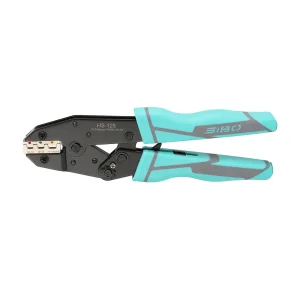
In-house forged carbon alloy frames calibrated to meet micro-ohm electrical transition requirements across automated and industrial wire harness infrastructures.
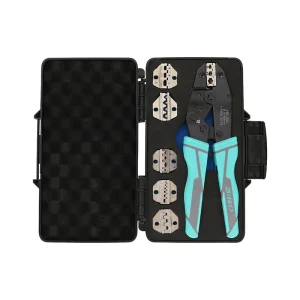
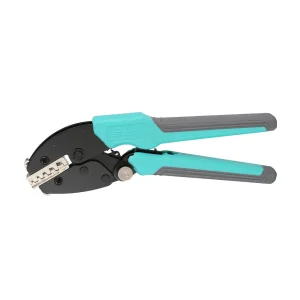
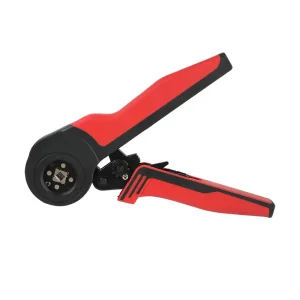
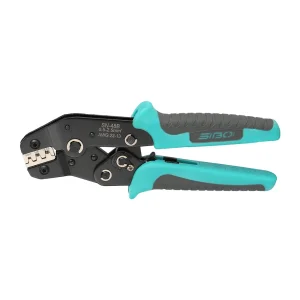
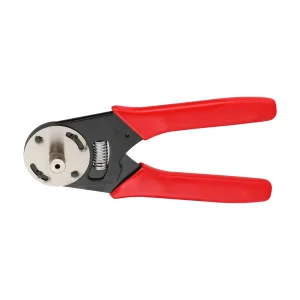
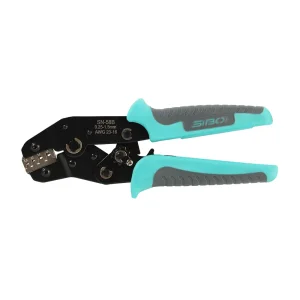
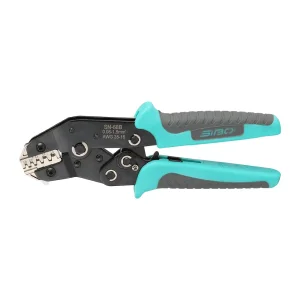
As automated control cabinets, renewable solar grids, and e-mobility drive unprecedented circuit density, wire termination standards have moved from simple manual clamping to geometrically verified, gas-tight mechanical cold-welds.
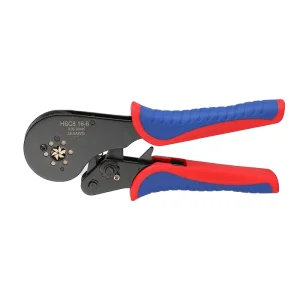
Traditional fixed-jaw tooling often resulted in under-crimping small conductors or shearing larger stranding. Contemporary self-adjusting mechanisms continuously distribute force around four-mandrel (quadrilateral) or six-mandrel (hexagonal) profiles, automatically adapting across 0.08 mm² to 16 mm² wires without manual die re-indexing.
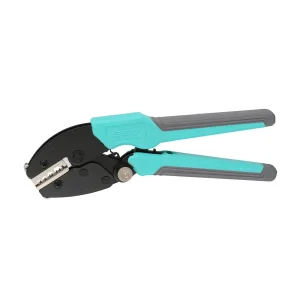
Under vibration and thermal cycling, microscopic air pockets inside stranded wire terminations cause rapid copper oxidation and catastrophic thermal runaway. Calibrated ratchet mechanisms mandate full stroke cycle completion, producing homogenous cross-sections meeting strict DIN EN 60947-1 interfacial conductivity limits.
Production line wiring demands high-repetition duty cycles. Contemporary tooling utilizes lever-ratio engineering that reduces operational squeeze resistance by upwards of 32%. Multi-component handles manufactured from anti-slip elastomers distribute palm pressure evenly to mitigate repetitive strain injuries (RSI) across industrial personnel.
| Crimp Profile Type | Primary Wire Cross-Section | Pull-Out Retention Force | Contact Resistance Threshold | Industry Standard Compliance |
|---|---|---|---|---|
| Hexagonal Self-Adjusting (6-Mandrel) | 0.25 – 6.0 mm² (AWG 24-10) | ≥ 230 N (6.0 mm²) | ≤ 1.2 mΩ | DIN 46228 Part 1/4, UL 486F |
| Quadrilateral Linear (4-Mandrel) | 0.08 – 16.0 mm² (AWG 28-6) | ≥ 400 N (16.0 mm²) | ≤ 0.9 mΩ | IEC 60999-1, EN 60352-2 |
| Pre-Insulated Oval Die (SO-Series) | 0.5 – 6.0 mm² (AWG 22-10) | ≥ 200 N (6.0 mm²) | ≤ 1.5 mΩ | UL 310, CSA C22.2 No. 153 |
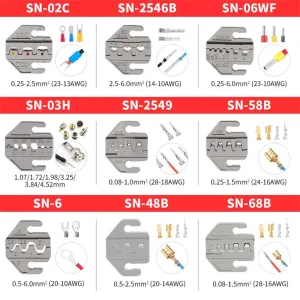
| Open-Barrel B-Crimp (SN-Series) | 0.1 – 2.5 mm² (AWG 28-14) | ≥ 140 N (2.5 mm²) | ≤ 2.0 mΩ | SAE/USCAR-21, ISO 19642 |
How tier-1 tool distributors, EPC contractors, and automation hardware manufacturers mitigate procurement risks via centralized Yueqing manufacturing integration.
Custom dual-color handle molding, permanent laser-etched branding, unified packaging aesthetics, and localized barcodes optimized for multi-national hardware chains.
Proprietary tooth geometries custom wire-EDM processed from high-chromium Cr-Mo tool steel, engineered specifically around unique customer terminal dimensions.
Strategic order staging programs for long-term distributors, offering rolling delivery release schedules that eliminate container supply chain disruptions and volatile shipping costs.
Optical dimensional verification, microscopic metallographic profiling, and automated tensile rupture testing performed across every batch prior to overseas container sealing.
Ensuring tool reliability meets international regulatory thresholds for field deployments across the European Union, North American industrial facilities, and Asia-Pacific grid operators.
SIBO electrical hand tools comply rigorously with EU RoHS Directive 2011/65/EU and REACH regulations. Our insulation materials pass dielectric testing up to 1,000V for designated lines, satisfying EN 60900 electrical insulation benchmarks.
Every batch of ratchet mechanisms is calibrated against ANSI/UL 486A-486B and UL 486F standards, ensuring crimped ferrules maintain mechanical tensile stability under intense terminal torque application and continuous dynamic field operation.
Our Yueqing-based engineering team operates with multilingual technical support desks (English/Chinese). We offer comprehensive terminal pull-test documentation, calibration certificates, and video QA verification prior to overseas shipment dispatch.
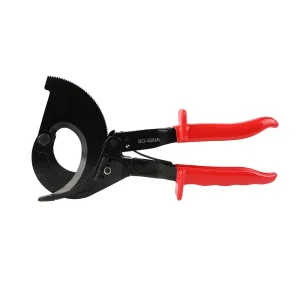
Precision shears, modular jaw kits, and heavy-duty ratcheting cable prep equipment engineered for harsh continuous use in switchboards, power distribution, and robotics.
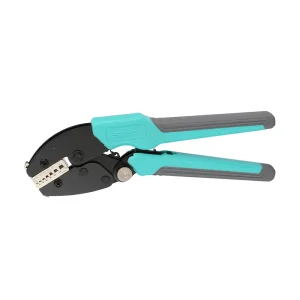
Where professional hand crimp technology is heading over the next five years to meet Industry 4.0 data logging, zero-defect quality thresholds, and sustainable manufacturing.
Next iterations incorporate micro mechanical cycle counting meters into the handle frame, alerting assembly supervisors when tool wear reaches recalibration intervals (e.g., at 30,000 and 50,000 cycles) to ensure zero defect rates on high-spec harness lines.
Moving from conventional milled tool steel to powdered metallurgy and vacuum-sintered alloy jaw inserts. This elevates Rockwell surface hardness beyond HRC 62, significantly expanding wear resistance across abrasive tin-plated and nickel-plated copper sleeves.
R&D commitment targeting 40% recycled or bio-circular elastomer resins in grip handles by late 2026 without sacrificing solvent resistance, flame retardance (UL 94V-0), or drop impact stability in sub-zero working environments (-20°C).
Transparent answers directly from SIBO factory engineers regarding die compatibility, certification, bulk MOQ terms, and custom tool manufacture.