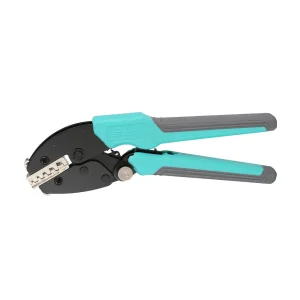
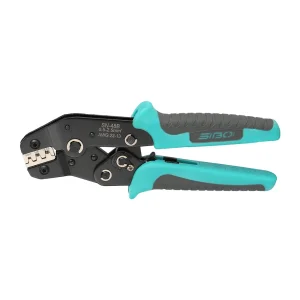
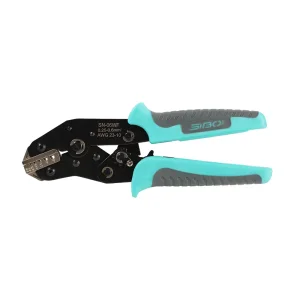
Precision-machined high-carbon steel crimping tools engineered for repeatable cold-weld crimp terminations, calibrated ratchet releases, and extended mechanical endurance across high-throughput production lines.
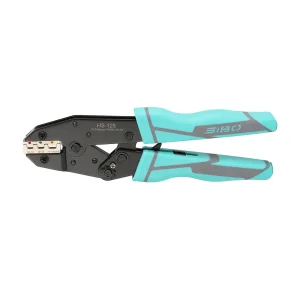
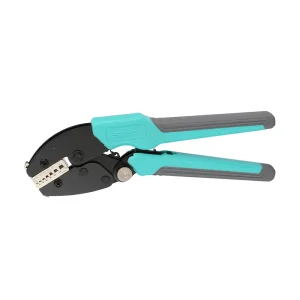
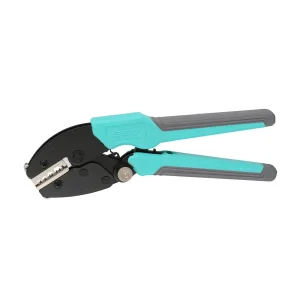
Analyzing the shift from manual compression clamping to micro-calibrated, metallurgical cold-welding joints in modern industrial electromechanical infrastructure.
In high-reliability industrial automation, renewable energy power plants, and modern e-mobility harness production, the terminal crimper is no longer viewed as a passive hand tool. Rather, it is engineered as a handheld precision press. A compliant electrical crimp does not merely squeeze a copper or alloy conductor into a tin-plated sleeve; it induces plastic deformation under strictly controlled hydrostatic pressures. This mechanical displacement fractures surface oxide layers on individual wire strands, promoting atomic intermetallic fusion—effectively creating an airtight, gas-tight cold weld that resists environmental oxidation, galvanic degradation, and thermal expansion cycling.
Historically, generic plier tools relied completely on technician hand force, yielding severe variance in crimp height, asymmetric barrel ears, and excessive void percentages inside the conductor cross-section. Contemporary precision manufacturing led by specialized factories like Yueqing Sibo Tools Manufacture Co., Ltd. addresses this via synchronized full-cycle ratchets, micro-finished Electrical Discharge Machining (EDM) die profiles, and carbon-alloy tool steels heat-treated to 42–48 HRC.
Micro-cavity die geometry achieves over 85% conductor compaction, driving out air and corrosive atmospheric contaminants to maintain near-zero micro-ohm contact resistance across decades of operation.
Factory-calibrated eccentric pawl mechanisms prevent premature jaw release. Once initiated, the crimp stroke cannot be aborted until target mechanical compression depth is completely attained.
Eliminating traditional stamped cavities, wire EDM tooling achieves ±0.008 mm dimensional consistency, preventing micro-burrs, wire shearing, or terminal sleeve wall perforations.
Why tier-1 global distributors and engineering EPCs audit factory metallurgical consistency, repeatability indices, and Statistical Process Control (SPC).
For international supply chain managers and brand directors, procuring crimping tools requires evaluating the Total Cost of Ownership (TCO). A low-cost crimper built from sub-grade stamped steel rapidly develops pivot-pin loosening, asymmetric die alignment, and ratchet teeth wear within 2,000 cycles. In mission-critical environments, an under-crimped ferrule or solar PV contact that loosens under thermal vibration can trigger multimillion-dollar equipment outages, fire hazards, or severe field warranty recalls.
Yueqing Sibo Tools mitigates supply chain risks through end-to-end vertical manufacturing within our Yueqing facility. By controlling the entire chain—raw carbon steel procurement, CNC progressive stamping, vacuum heat treatment, and Cpk statistical validation—we provide procurement partners with guaranteed MTBF (Mean Time Between Failures) exceeding 30,000 crimping operations.
| Evaluation Parameter | Commodity Plier Suppliers | SIBO Engineering Standard Factory | Global Industry Compliance Target |
|---|---|---|---|
| Frame Material & Treatment | A3 / Q235 Stamped Steel (Untreated) | High-Grade Tool Carbon Steel + Vacuum Hardening | Deformation Resistance > 1200 N Force |
| Die Cavity Manufacturing | Cast Molding / Low-Tolerance Die Cast | Precision CNC Machined & Wire Cut EDM | Tolerance within ±0.01 mm |
| Ratchet Mechanical Longevity | < 3,000 Cycles before failure | 30,000+ Full Cycles without loss of pressure | DIN EN 60352-2 Compliance |
| Crimp Height Repeatability | High Drift (Std Dev > 0.15 mm) | Controlled Tolerance (Cpk > 1.67, < 0.03 mm) | UL 486A / USCAR-21 Validation |
| Ergonomic Hand Force | Excessive Strain (> 350 N required) | High-Leverage Mechanical Advantage (< 180 N) | ISO 10075 Ergonomic Guidelines |
Tailoring mechanical force curves, nest geometry, and crimp profiles to the unique demands of global industrial sectors.
Dedicated solar crimpers (SO-2546 Pro Series) designed specifically for MC4-type open and closed contacts on 2.5, 4, and 6 mm² PV cabling. Engineered to prevent hot spots, arc faults, and maintain watertight IP68 solar string reliability.
Optimized B-crimp profiles (SN-48B, SO-06B Pro) tailored for non-insulated open-barrel automotive terminals and heavy-duty Deutsch DT connectors. Meets stringent USCAR-21 pull-off force and cyclic vibration durability standards.
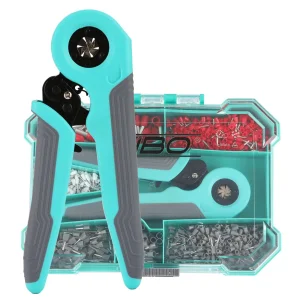
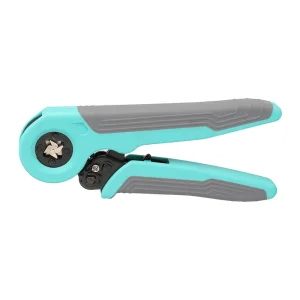
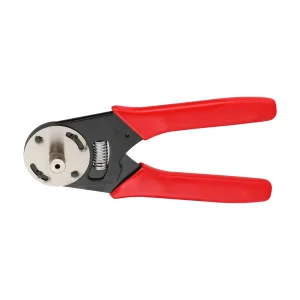
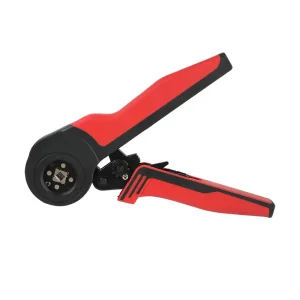
Self-adjusting quadrilateral and hexagonal ferrule crimpers (SO 10-4, SO 16-4) that automatically adapt across 0.08 to 16 mm² wire-end sleeves. Ensures smooth insertion into spring-clamp terminal blocks and industrial contactors.
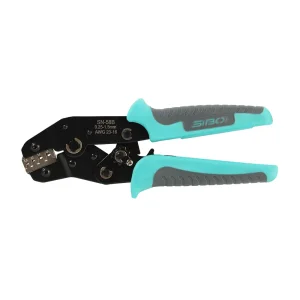
Ultra-fine pitch ratcheting tools (SN-58B, closed-barrel Deutsch crimpers) delivering micro-crimps on Dupont, JST, Molex, and D-Sub 20-16 AWG contacts. Features simultaneous conductor and insulation strain relief crimping.
Meeting and exceeding the rigorous testing benchmarks mandated by North American, European, and Asian electrotechnical bodies.
Exporting electrical tools into regulated markets requires strict adherence to international standardizations. A crimp connection is treated as an active electrical component by certifying authorities. Yueqing Sibo Tools subjects all die sets and ratchet mechanisms to rigorous mechanical and metallurgical validation protocols:
Mandates pull-out retention force limits and cross-sectional compaction criteria for non-soldered crimped joints. Our tools ensure zero strand fracture while exceeding tensile release thresholds by up to 25%.
Evaluates long-term current cycling and mechanical pull tests under continuous current load. Sibo-crimped lugs prevent localized thermal heating, ensuring safety in industrial control panels.
Governs wire-end ferrules with and without insulating plastic sleeves. Our self-adjusting SO-series provides precise square and hexagonal form profiles matching European DIN rail blocks.
Anticipating the technological demands of Industry 4.0, advanced ergonomic materials, and integrated traceability systems.
Integrating micro-piezoelectric sensors and NFC connectivity into tool handles to track cycle count, pressure peaks, and trigger preventive maintenance alerts on production lines.
Applying PVD hard coatings to tool jaw nests to reduce friction coefficients by 60%, drastically minimizing copper plating pick-up and tripling die operational lifespans.
Dual-component thermoplastic elastomer (TPE) handles configured with variable-leverage mechanical linkages, reducing peak wrist strain and repetitive strain injuries (RSI) for line technicians.
Comprehensive cable cutting, self-adjusting ferrule crimping pliers, and complete electrical tool kits engineered for demanding industrial contractors and distributors.
Direct, engineering-backed answers addressing critical search intent regarding terminal crimper calibration, tooling metallurgy, and factory customization.
Standard plier-action crimping tools rely solely on manual operator strength, introducing significant inconsistencies in crimp compression, barrel deformation, and pull-out retention. In contrast, precision ratchet crimping pliers incorporate a mechanical full-cycle ratchet and eccentric pawl assembly. The tool jaws lock mechanically and will not disengage until the stroke reaches its exact pre-set mechanical bottom-dead-center.
This guarantees that every terminal experiences 100% of its required compression depth, eliminating operator fatigue-induced under-crimping. Furthermore, integrated quick-release safety levers permit clearing improper terminal insertions or jams without damaging the die nest.
UL 486A-486B and IEC 60352-2 define strict minimum tensile retention forces (measured in Newtons or pounds-force) required to separate a crimped terminal from its conductor without breaking. SIBO achieves strict compliance via two core methodologies:
The choice is dictated by wire variety and assembly context:
As a factory-direct manufacturer located in Yueqing, Zhejiang, SIBO provides comprehensive OEM/ODM solutions tailored for international brand owners, tool wholesalers, and private labels:
Terminal crimp failure often traces back to poor wire preparation. Using generic diagonal cutters or dull shears crushes copper conductors into an elliptical, splayed shape, fracturing delicate strands and preventing full insertion into terminal sleeves.
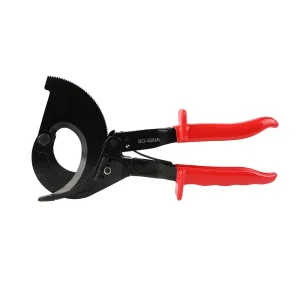
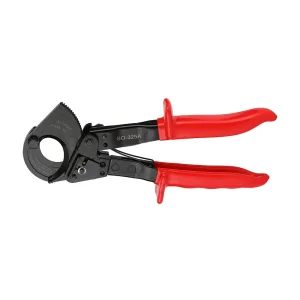
SIBO's heavy-duty ratchet cable cutters (such as the FST-520A and FST-325A) utilize sickle-shaped curved cutting blades manufactured from high-grade molybdenum-vanadium tool steel. The blade geometry shears cleanly through copper and aluminum conductors without crushing, maintaining conductor concentricity for seamless sleeve insertion and uniform 360-degree radial crimp compression.
